Bishop Media Sports Network
What’s Next For Jaguars?




 By: Michael Spiers
TheSouthernSportsEdition.com news services
The Jacksonville Jaguars ended their 2025 season with heartbreak, but also with something that felt unfamiliar after years of turbulence: real optimism.
A 27–24 Wild Card loss to the Buffalo Bills closed the book on a 13–5 campaign that saw Jacksonville win the AFC South and return to the postseason.
For a franchise that finished 4–13 just a year earlier, the turnaround under head coach Liam Coen was nothing short of dramatic.
The Jaguars went from organizational reset to division champion in one offseason, and the foundation now looks sturdier than it has in years.
Jacksonville’s renaissance began with sweeping changes at the top.
After the disappointing 2024 season, the Jaguars parted ways with head coach Doug Pederson and general manager Trent Baalke, ushering in a new era led by Coen and general manager James Gladstone.
Rather than chase splashy free-agent headlines, the new leadership group focused on targeted additions, internal development, and building a roster that fit Coen’s vision on both sides of the ball.
The results were immediate. Jacksonville opened the season with statement wins over Carolina, Houston, and San Francisco, establishing itself as a legitimate contender early.
Trevor Lawrence delivered the best year of his career, posting his highest QBR while operating in an offense that finally maximized his strengths. Injuries and off-field distractions, including ongoing “stadium of the future” planning, could not derail the Jaguars’ momentum.
By season’s end, Jacksonville had claimed the division and a playoff berth, signaling that the rebuild had arrived ahead of schedule.
The playoff loss to Buffalo stung, but it did little to dampen the sense that Jacksonville is trending in the right direction.
While the Jaguars face tough free-agency decisions, they appear to be on the right track on both sides of the ball, as well as off the field.
In a division where Houston, Indianapolis, and Tennessee each face their own questions, Jacksonville’s trajectory stands out.
Still, Year 2 of the Coen era may prove even more challenging than Year 1.
The Jaguars enter the offseason roughly $21 million over the salary cap, limiting their ability to shop for premium talent.
Several key contributors face uncertain futures, including linebacker Devin Lloyd, cornerback Montaric Brown, and running back Travis Etienne.
Lloyd, coming off a breakout season, is poised to command top-market money, while Etienne and Brown will test Jacksonville’s ability to balance financial realities with roster continuity.
Defensive tackle, cornerback depth, and pass rush remain priorities, meaning the draft will likely play a central role in shaping the 2026 roster.
One of the most encouraging developments of the offseason so far is stability on the coaching staff.
Offensive coordinator Grant Udinski, one of the youngest and most highly regarded play callers in the league, drew head coaching interest from Buffalo and Cleveland.
Ultimately, the Bills hired Joe Brady, allowing Jacksonville to retain Udinski with a pay raise and continued influence over Lawrence’s development.
Udinski’s reputation as a rising offensive mind, often compared to Sean McVay’s early career path, underscores the growing respect Jacksonville has earned across the NFL.
Head coach Liam Coen has long praised Udinski as an elite communicator and a coach with no ego, a rare combination that has helped shape Jacksonville’s offensive identity.
Keeping that continuity could be as important as any player signing, especially as the Jaguars prepare for Travis Hunter’s expected two-way role in 2026.
For Jacksonville, the mission now is clear. The Jaguars must transition from surprise contender to sustained contender.
That means navigating a tight salary cap, making difficult roster decisions, and continuing to build through the draft while maintaining the culture Coen and Gladstone have established.
The 2025 season ended short of a Super Bowl run, but it reintroduced Jacksonville to the NFL’s upper tier.
The Jaguars are no longer a rebuilding afterthought. They are a team with a quarterback in his prime, a coaching staff in demand, and a front office that appears to have a long-term plan.
The hard part now is staying there.
Killer Kirby

 By: Joe Delaney
TheSouthernSportsEdition.com news services
The Georgia Bulldogs have played NCAA Football for 122 years.
During that time they have won over twice as many games as the have lost. That is a very good record.
In the last 30 years the Bulldogs have had a winning record in 28 of those seasons. Not many schools have had that kind of success.
But in the last 10 seasons the Bulldogs have won 117 games. That includes multiple SEC Championships and multiple NATIONAL CHAMPIONSHIPS. They have gone from good, to great, to arguably the best college football program in the country.
How did the Dawgs accomplish this? The answer can be summed up in one word, KIRBY.
Leaving Alabama after the 2015 season, Kirby returned to his alma mater where he was an All-SEC defensive back in the 90’s.
Starting with 2016 season, Smart led Georgia to an 8-5 record and a 31-23 win in the Liberty Bowl. Humble beginnings. It was just a mere taste of what was to come.
The 2017 season was highlighted by the 54-48 double overtime win over the Oklahoma Sooners. And while the Dawgs would lose in the National Championship to Alabama that year. The dye was cast.
The Dawgs have gone on during these 10 years to more SEC championships and 2 national championships.
The first National Championship being a thrilling win over the nemesis Crimson Tide 33-18 in 2021. The Dawgs then went 15-0 and back to back in 2022 with the cap being a 65-7 crushing of TCU in the final.
In Kirby Smart the Georgia Bulldogs have the best football coach in the NCAA.
They have become in Coach Smarts words “elite”.
In 2025 the Dawgs went 12-2. The lost 2 games were by a total of 8 points.
They won another SEC championship and finished ranked in the top 5.
Ask a gazillion Georgia fans and they will say it was a good year. A good year? Yeah, that’s it. That’s how high Kirby Smart has set the bar at UGA.
His favorite saying is that “you’re elite or you’re not”. Never has a Georgia football coach expected so much from himself, his players, his team and school. That’s saying a lot when you look back at all the great Georgia coaches.
So how did Kirby Smart go from eating hamburgers at Twin Lakes and coaching linebackers at Valdosta State University to being the head honcho of college football? Two reasons with one being just as important as the other.
First, you coach for almost a decade under the best college coach ever. You coach with Nick Saban every day and you learn and learn and learn. You grow with the guy and when your time comes, you’re ready.
And the second is you bleed Red and Black. Your family bleeds red and black. Kirby isn’t a coach for hire. He’s a damn DAWG. Those two things are what have made him he is. And that is ELITE.
The Welcome Wagon

By: Michael Spiers
TheSouthernSportsEdition.com news services
Camden County High School recently officially welcomed Tucker Pruitt as the new head football coach during an introductory ceremony that highlighted his vision for the Wildcats program, his extensive coaching background, and his commitment to developing student-athletes on and off the field.
Pruitt opened by thanking Superintendent Dr. Green, Principal Dr. Phillips, and Athletic Director Welton Coffey, noting the extensive behind-the-scenes work that goes into a major coaching hire.
He emphasized the importance of strong administration in building successful athletic programs and said he had been impressed with the organization and resources already in place at Camden.
After just a week on campus, Pruitt said he had already spent time in the weight room and meeting with coaches, praising both the structure of the program and the large number of athletes participating.
The new head coach acknowledged that leaving Appling County was difficult but said the opportunity to lead Camden County was one he could not pass up.
He described the position as one of the premier jobs in high school football and said it was an easy decision for him and his family, even after a recent move.
Pruitt also noted the challenges ahead, calling Region 1 one of the toughest regions in the country and comparing it to the SEC in terms of competition, resources, and coaching quality.
Rather than being intimidated, he said he is excited to embrace that challenge.
Pruitt outlined three core pillars that will define the Wildcats moving forward: discipline, accountability, and toughness.
He explained that discipline is about how the team approaches every detail, from weightlifting to practice, and that winning often comes down to avoiding mistakes.
Accountability will be reinforced through a team-based scoring system that tracks attendance, effort, discipline, and academics, with points awarded for grades and performance and deducted for missed workouts or disciplinary issues. Pruitt said this system will help him evaluate trust and commitment among players and instill championship-level standards.
Toughness, he said, remains central to football. Pruitt stressed both physical and mental toughness, emphasizing preparation for adversity and the importance of responding to setbacks during games.
He said Camden will strive to play a physical brand of football on both offense and defense, focusing on fundamentals, aggression, and consistent effort.
His goal is for opponents to feel the cumulative impact of that physicality over four quarters and recognize Camden as a program that plays hard and with purpose.
During a question-and-answer session, Pruitt detailed his coaching background, which began as the son of a high school coach and included playing at Valdosta State University on national championship teams.
His coaching career has included stops at Georgia Southern, Valdosta High School, Thompson High School, Coffee County, Lowndes, and Valdosta, where he won a state championship as offensive coordinator.
He served eight seasons as head coach at Fitzgerald, reaching the state semifinals or better six times, including a state championship, before leading Appling County to an 8-4 season and a region title in 2025.
Pruitt also discussed the Wildcats’ upcoming schedule, which includes non-region games against Brunswick, Glynn Academy, Benedictine, Ed White, Godby, and West Volusia, followed by region matchups with Lowndes, Richmond Hill, Valdosta, and Colquitt County.
He noted that scheduling has become increasingly competitive and that Camden is prepared to face top-level opponents.
When asked about defensive philosophy, Pruitt said his approach will be balanced and multiple, focused on stopping the run, limiting explosive plays, creating turnovers, and adapting weekly to opponents. He emphasized fundamentals over scheme and the importance of pressure and coverage working together.
Pruitt closed by expressing excitement about joining the Camden County community and building relationships with players, faculty, and fans.
He said his ultimate goal is to develop young men for life beyond football while producing a program the community can be proud of on Friday nights.
New Captain Talks Pirate Football
 By: Teddy Bishop
TheSouthernSportsEdition.com news services
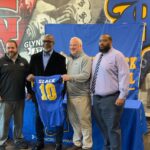
The Glynn County Board of Education has hired Dr. Byron Slack to lead the Brunswick High School football program.
Dr. Slack succeeds Garrett Grady, who resigned as BHS head coach in December, after four years at the helm.
Dr. Slack recently sat down with me for an exclusive interview for the Southern Sports Edition.
“This is a program where there are already good players,” he said when asked what attracted him to Brunswick High.
“Not too many positions with a 9-3 record come open. I watched film on these guys and knew I would like to coach them.”
Slack comes to BHS after four years as head coach at Cook County, where he led the Hornets to four straight playoff appearances, including a semi-final appearance 2023.
The semis certainly sound good to Pirate Nation. Brunswick High has not made it past the second round of the playoffs since 1999 when Head Coach John Willis marched his Pirates—unbeaten—to the state championship game, only to lose to the Lowndes Vikings, 18-0.
Coach Slack compiled a 28-21 record at Cook County, and is 32-25 overall as a head coach.
Slack is originally from Anchorage, Alaska, but moved to Georgia going into high school. He is one of eight children, including a twin brother.
He and his wife Frances have one son, Zion, a senior at Middle Georgia.
Slack graduated from the University of West Georgia, where he played football and was a first-team All-American. He earned his Doctorate from Nova Southeastern University.
Slack has some 25 years of experience coaching at the high school level, starting as assistant coach at Dunwoody High School in 1996.
He also has experience in the college ranks, coaching two years at Minnesota State University, and three years at his alma mater, West Georgia.
In 2005, Slack accepted a coaching position at Camden County under Jeff Herron. He spent 13 years at Camden, first as the offensive line coach, then the defensive line coach, and ultimately, as defensive coordinator. He was on the staff of the Wildcats state championship teams of 2008 and 2009.
Slack also spent three years at Lowndes as Defensive Coordinator, which included a trip to the 7-A semi-finals in 2018, and a trip to the finals in 2019.
In 2020 (the Covid year), Slack accepted his first head coaching job, at Hillgrove where the Hawks finished with four wins and five losses.
In 2021, he became the Assistant Head Coach at Colquitt.
In 2022, Cook County tabbed him as its Head Coach.
When asked about his coaching staff, Slack said he hasn’t finalized it yet. “I have three or four guys I’m going to bring in,” he said. “The bulk of the staff will remain intact, but I may move some guys around.
“Coach Belker will return as offensive coordinator.” Belker, of course, has been instrumental in the Pirates putting up big numbers on offense.
“We will continue to run the spread,” Slack acknowledged. “We’ll run power and counter and take advantage of our two, one-thousand-yard rushers.”
“On defense,” Slack said, “we’ll be a 3-4 team, but we’ll be moving and slanting and bringing pressure from different spots.”
The Pirates have had trouble stopping the run between the tackles from time to time, but with Slack’s experience as a defensive coordinator, that may be a thing of the past.
When I asked Slack about the brawl with Gainesville, he didn’t shirk away from the question. “I’ve addressed it with the players,” he said, “and we’re going to own it. We’re going to own it, learn from it, and move on.”
“Everybody’s going to be watching this program,” he continued. “What a great opportunity it is to show that it was an isolated incident, and that’s not who we are. We’re going to prove to everybody we will win football games the right way.”
I believe the Pirates have the right man for the job.
Champions

 By: Robert Craft
TheSouthernSportsEdition.com news services
As a south Florida breeze blew through the night, Miami native Fernando Mendoza and the Indiana Hoosiers ascended to the throne of college football — and entered the all-time lore of American sports.
Mendoza’s twisting, turning, bouncing-off-defenders touchdown in the fourth quarter will be replayed forever. This Indiana team broke all the molds, shed all their historical baggage and won the national championship.
Your 2025 Indiana Hoosiers. 16-0. National champions.The dream season is real.
Indiana. National champions. Of football.
The unflappable coach Curt Cignetti led a perennial bottom dweller to the College Football Playoff in 2024, boldly stated over the summer that wasn’t enough — hammering the phrase “No self-imposed limitations” — then marched his troops to a storybook season in his second year in Bloomington.
The Hoosiers are the first team in the history of any major-college sport to have the most all-time losses in a sport then go on to win a national championship.
“I don’t think there’s anything that compares to this, even if they don’t win Monday night,” longtime broadcaster Sean McDonough said during Friday’s CFP media day.
But they did win. The Hoosiers aren’t a plucky upstart or an underdog darling or any other warm and fuzzy placeholder.
The Indiana Hoosiers are the national champions of college football.
And they did so by marching through some of the biggest names in the sport.
Indiana finished the regular season unbeaten, then started their postseason march by handling No. 1 Ohio State 13-10 in the Big Ten title game. The Buckeyes, averaging 33.4 points per game, scored only one touchdown after an Indiana turnover deep in IU territory.
The Hoosiers postseason run is a noteworthy one: They crushed Alabama 38-3 in the Rose Bowl, then blew Oregon’s doors off 56-22 in a CFP semifinal at the Peach Bowl in Atlanta.
When forced to play the Hurricanes on their home field for the national title, Indiana handled Miami 27-21.
Surviving multiple cheap shots from Miami that even rules analysts said should have been targeting, Mendoza pinballed himself into the end zone with 9:18 left in the game to give the Hoosiers a 24-14 lead.
It wasn’t any touchdown run. It was fourth-and-4 from the Miami 12, national championship on the line. Cignetti called timeout after third down, went for it on fourth down.
Mendoza bounced off at least six defenders before launching himself upward and sideways into the end zone. As he scored, television cameras shifted to his mother, who is in a wheelchair due to M.S., and Elsa’s reaction was one of joy, shock and near tears as she was hugged by family members.
Legendary play call. Legendary play. Legendary reaction.
Jamari Sharpe sealed the outcome when the Hurricanes had a chance to steal it away. Sharpe slipped inside a route by Keelan Marion and picked off Carson Beck on a first-and-10 from the Indiana 41, and. Sharpe made the smart play from Sharpe was— a poetic ending for a Curt Cignetti’s -coached team — taking a knee with 0:44 on the clock.
An excessive celebration flag was thrown on Indiana after Sharpe’s interception, but after years, decades, even generations of frustration, the world can throw an excessive celebration flag on Hoosier Nation and no one will care.
The Hoosiers have six wins over top-10 teams: No. 1 Ohio State (neutral site), No. 3 Oregon (on the road), No. 5 Oregon (neutral site), No. 9 Alabama (neutral site), No. 9 Illinois (home), No. 10 Miami (the Canes’ home stadium in the national title game).
In those six wins over top-10 teams, IU has won by a combined score of 227-86
As Mendoza stood on the field waiting to do the ESPN postgame interview, red and white confetti falling on his head, his gaze drifted upward and he seemed to mouth “Thank you” to no one in particular.
And this comes with tremendous synergy: 50 years ago, Bob Knight’s 1976 basketball team went 32-0 to win the national title. So Indiana has an unbeaten football national championship and an unbeaten basketball national championship.
The Indiana Hoosiers, national champions of college football.
Jason Bishop Show Janaury 16 2026


Crownless SEC

By: Michael Spiers
TheSouthernSportsEdition.com news services
For those of us who grew up believing the SEC was not just a conference but a force of nature, the last couple of seasons have felt… unsettling.
Not catastrophic. Not embarrassing. But different.
And when you love the SEC the way some of us love it, when you’ve measured fall Saturdays by kickoff times in Athens and lived and died with the Georgia Bulldogs, “different” can feel like an existential threat.
Let’s start with the uncomfortable evidence.
Two straight national champions from the Big Ten, and possibly a third after next Monday. And now, two straight title games without an SEC logo anywhere near the field.
Alabama got pushed around by Indiana in a way that would have been unthinkable a decade ago.
Bowl season numbers that don’t lie, even if we try to explain them away. Middle-of-the-pack SEC teams losing to middle-of-the-pack Big Ten and ACC teams.
That mystique Curt Cignetti dismissed before his team throttled Alabama? It wasn’t disrespect. It was reality.
And yet, if you’re asking whether the SEC is still the king of college football, the honest answer depends on how you define “king.”
If king means untouchable, inevitable, and hoisting the trophy every January like it’s preordained, then no. That era is over. Probably forever. The sport has changed too much for that kind of monopoly to exist again.
NIL, the transfer portal, revenue sharing, and an expanded playoff have done what no conference alignment or coaching carousel ever could. They’ve redistributed power.
The SEC once thrived on accumulation. Georgia, Alabama, LSU, Florida. They stacked recruiting classes so deep that second strings looked like NFL practice squads.
Kirby Smart’s two-deep defenses during Georgia’s championship run were absurd. Alabama once had four future first-round receivers on the same roster. That’s not happening again.
The four-star kid who used to wait his turn now leaves. The backup guard wants to start. The third receiver wants targets and NIL money. Depth evaporates.
That doesn’t mean the SEC is weaker. It means everyone else is stronger.
And this is where the conversation often loses nuance. The SEC hasn’t fallen. The sport has flattened.
When Illinois flips a running back from Alabama, when Indiana doesn’t flinch at the sight of crimson helmets, when Oregon, Ohio State, Michigan, and Penn State can all realistically believe they belong, that’s not an indictment of the SEC. It’s a reflection of a new ecosystem.
From a Georgia fan’s perspective, this is both frustrating and fascinating.
Frustrating because dominance was comforting. You knew that if the Bulldogs didn’t win it all, someone from “our side” probably would. Fascinating because now, winning actually means something again.
The margin for error is gone. The invincibility is gone. And the sport feels alive in a way it hadn’t for years.
The SEC is still loaded. The league still produces NFL talent at an absurd rate. It still commands the biggest TV audiences, the loudest stadiums, and the deepest emotional investment. Walk into a bar in Athens, Tuscaloosa, Baton Rouge, or Knoxville on a fall Saturday and tell me this league has lost its soul. It hasn’t.
What it has lost is its insulation.
Georgia still recruits at an elite level. Alabama still signs blue chips. Texas has arrived with resources to match anyone. LSU reloads every year. Ole Miss can still win it all. But none of them can hoard talent anymore. None of them can sleepwalk through November. None of them can assume January belongs to them.
And maybe that’s the real test of kingship.
Because the SEC isn’t being dethroned by one rival or one conference. It’s being challenged by parity. By accessibility. By a sport that no longer allows any region to lock the door behind it.
As someone who bleeds red and black, who still believes Georgia under Kirby Smart is capable of winning it all in any given year, I don’t see this as the end of SEC supremacy. I see it as the end of SEC entitlement.
The crown isn’t gone. It’s just heavier now.
And the truth is, if the SEC really is what we’ve always claimed it to be, then it will adapt.
It will evolve. It will win again. Just not automatically. Not easily. Not without earning it.
Which might be the most SEC thing of all.
Falcons Changing Flight Path

 By: Kenneth Harrison
TheSouthernSportsEdition.com news services
The NFL regular season has ended and as expected, several coaches were fired.
The Atlanta Falcons fired General Manager Terry Fontenot and head coach Raheem Morris. I love that move because I think the GM should be removed with the head coach when a team wants to move in a different direction.
Atlanta made an interesting move after this by hiring Matt Ryan as their president of football. He’s a former great player for the Falcons and he currently is an analyst on CBS. He gets to keep that job by the way while working in Atlanta’s front office.
Some of the other names that were interviewed for the position were Ian Cunningham, Chicago Bears assistant General Manager, Mike Disner, Detroit Lions Chief Operating Officer and Josh Williams, San Francisco 49ers Director of Scouting and Football Operations. The other guys seem to fit this role a bit better, if we’re being honest.
Ryan’s role as the president of football in Atlanta isn’t simply an advisory role. He’ll have a “strong voice” in the franchise’s decision making, similar to how former quarterback John Elway ran the Broncos as the executive vice president of football operations and general manager from 2011 to ‘21 before stepping into an advisory role in ‘22.
I liked Ryan as a player but I’m not thrilled with him having this title because he does not have experience beyond playing football.
“Arthur gave me the chance of a lifetime almost 20 years ago, and he’s done it again today,” Ryan said. While I appreciate the time I had with the Colts and with CBS, I’ve always been a Falcon. It feels great to be home. I could not be more excited, grateful, or humbled by this new opportunity. I began my career with a singular goal: to do right by the Blank family, the Falcons organization, the city of Atlanta, and especially our fans. My commitment to the success of this franchise has not changed. I’m beyond ready to help write a new chapter of excellence.”
Atlanta has not made the playoffs in eight seasons. They have a lot of talent on the roster but they need to hire the right duo as GM and Head Coach.
So far, four coaches have been interviewed for the Head Coach position. They are Seahawks Offensive Coordinator Klint Kubiak, Dolphins Defensive Coordinator Anthony Weaver, Seahawks Defensive Coordinator Aden Durde and ex-Browns Coach Kevin Stefanski were interviewed by the team.
Former Dolphins Head Coach Mike McDaniel will interview for the position. I know Atlanta also wants to interview John Harbaugh.
For the GM position, Atlanta has contacted Ian Cunningham. He’s Chicago’s assistant GM.
Atlanta looks like a decent position because they have some good players. The biggest question with the roster is quarterback though.
Starter Michael Penix Jr. suffered a partially torn ACL in Week 11 against Carolina. He suffered two torn ACL’s when he played at Indiana.
He was in his second season but he did not play well consistently before the injury. The other option at QB is Kirk Cousins.
Cousins signed a four-year, $180 million contract with Atlanta in March of 2024. He has been a disappointment thus far and he’s 37.
I’m hopeful Atlanta hires people that can make them a contender again.
Doubt If You Dare

By: Robert Craft
TheSouthernSportsEdition.com news services
The final offensive play Miami ran to earn a spot in the national championship had not been called by Shannon Dawson in a game this season.
Considering Miami’s offensive coordinator called a season-high 88 plays in final four 31-27 win against Ole Miss in the Fiesta Bowl — and more than 1,000 throughout the season — it’s noteworthy Dawson still had something the Rebels hadn’t seen yet.
It probably helps explain why Ole Miss left the entire left side of the field open for quarterback Carson Beck to tuck the ball and waltz his way into the end zone with 18 seconds left.
“We’ve been repping it probably for the last three games in that situation — for about a 4- or 5-yard-line play,” Dawson said. “We had a little condensed set (three receivers to the left) and were throwing an option route to Malachi (Toney). They covered it well and Carson just made a play, which was awesome. Sometimes we talk about at quarterback, if you exhaust your reads, go make a damn play. That’s what he did.”
Dawson’s play calling and Beck’s decision-making haven’t always produced pleasing results for the Hurricanes. There were probably some who questioned why Dawson called a pass play 3 yards from the end zone with 24 seconds left and a timeout still in Mario Cristobal’s pocket.
Miami had pounded the ball down the Rebels’ throats all night, and an Ole Miss sack or interception would be disastrous. Yet Miami’s coordinator and head coach were on the same page. It was time to put the game in Beck’s hands.
“I was gonna throw it there, and if I didn’t get it, I was gonna run it on third down,” Dawson said. “And then we would see, right?”
Dawson never had to figure out what to call on third down. Instead of forcing the ball to Toney in tight coverage and putting the ball in harm’s way, Beck made the right decision.
He’s done that a lot over the course of Miami’s seven-game win streak. While Beck is not putting up flashy numbers and continues to struggle connecting with receivers downfield (he was 1 of 7 on throws of 15-plus yards in the Fiesta Bowl), the Georgia transfer play is not hurting his team.
That’s as big a reason as any why Miami is advancing.
Beck’s teammates came to him after his midseason struggles and told him to let his mistakes go. They urged him to play free and reassured him they had his back.
When it was his turn to lead Miami down the field for the winning drive in the Fiesta Bowl, Beck said he told his teammates he had their back, regardless of the outcome.
“He’s a perfect example of a guy who just feels supported,” Cristobal said. “He’s hungry, he’s driven, he’s a great human being and all he wants to do is want to see his teammates have success. And that’s what we witnessed tonight.”
What did Beck’s teammates see late in the game from the Fiesta Bowl’s offensive MVP? Determination.
“All he said was, ‘Let’s go score,’” said CJ Daniels, who caught an 8-yard pass from Beck on third-and-6 with 1:25 to go to keep Miami’s final drive alive.
“The first thing he told me when he got here was if you wanna go win the natty, you’ve got to believe. Everybody knows he’s been through a lot. The whole world criticizes him. I just know I wouldn’t want to play with any other quarterback.”
Beck threw his second interception since the SMU loss — a span of 195 passes — on a batted ball on his final pass of the third quarter. He closed by completing eight of his last 13 passes in the fourth quarter for 93 yards and two touchdowns.
Keelan Marion, who led the Hurricanes with seven catches for 114 yards (including a 52-yarder for a touchdown on a busted coverage), said he went to Beck on the final drive and told him to get him the ball because he was confident he could beat whoever was covering him. Beck trusted him. Marion caught three passes on the drive, including the last two for first downs.
“Everybody doubted that guy,” Marion said, “and he’s been proving them wrong game by game.”
Is Beck capable of leading Miami to one more win on the Hurricanes’ home field against Indiana?
He’s 37-5 as a starting quarterback. It would be foolish to doubt him now.
Wayne County Yellow Jackets Hire New King Bee

 By: Colin Lacy
TheSouthernSportsEdition.com news services
Wayne County has found a new leader in Jesup. The Wayne County Board of Education unanimously approved Superintendent Toni Williams’ nomination of Scott Roberts as the new head football coach for the Yellow Jackets.
Roberts comes to Jesup after a 1-9 season that saw the departure of former head coach John Mohring after a 0-5 start.
Athletic Director and Head Baseball Coach Justin McDonald took over as interim head coach. In his first game as interim head coach, McDonald led the Yellow Jackets to their first win since 2023 on the field.
John Mohring, who just accepted the defensive coordinator position at Parkview High School earlier this week, technically resigned mid-September after a 0-5 start.
In the 15 games under Mohring between 2024 and the beginning of 2025, Wayne County was winless on the field.
One caveat to that was the 2024 matchup with Appling County. Appling defeated Wayne on the field, but Appling County was forced to vacate wins for the 2024 season due to GHSA violations in regard to recruiting and an ineligible transfer player.
Scott Roberts comes to Jesup after 11 seasons in two stints (including the last 9 years) leading the Swainsboro Tigers program.
Roberts amassed an overall record of 92-43 in his 11 seasons in Swainsboro including a 75-36 record since taking over the Tigers most recently in 2017.
Roberts had made the Tigers and the GHSA State playoffs synonymous with a playoff appearance in every season since he took over Swainsboro in 2017.
The playoff streak includes 3 region titles along with 2 state championship game appearances in back-to-back years of 2022 and 2023 as well as a semi-final game showing in 2021.
Prior to taking over for the Tigers, Roberts spent the 2013-2016 seasons at Bainbridge High School as the offensive coordinator for the Bearcats.
While in Southwest Georgia, Roberts helped the Bearcats to three consecutive playoff appearances including a semifinal match-up in 2015.
He has spent virtually his entire coaching career in South Georgia with stops on staff at Fitzgerald, Cairo, Colquitt, Tift County and Washington County.
After many years of success for Wayne County that came to a rather abrupt end when Jaybo Shaw left after the 2023 season, Justin McDonald did an admiral job getting the first win in almost 2 years, as well as trying to keep the team together and reset the program for the future.
There is plenty of optimism on the field entering the “Roberts Era” and feels like a critical time for the Yellow Jacket program.
While there are many more wins expected, the crucial part of this hire seems to be off the field with the relationships around the program.
Wayne County is an exceptionally invested community that rallies around the Yellow Jackets, and while there were some questions around that piece of the equation with Roberts in Swainsboro, it will be arguably the most important piece to embrace the community to be able to find success again in Jesup.
Wayne County is a program that has the support to be successful on the field, and quite frankly, the Yellow Jackets are a program that makes the South Georgia area better when they are at their best.
Scott Roberts has won everywhere he’s been and looks to continue that in Jesup!
Online

Radio/Podcasts