Robert Craft
Category 5

 By: Robert Craft
TheSouthernSportsEdition.com news services
Mario Cristobal started his celebration by posing for a photo with his family in front of the scoreboard at Doak Campbell Stadium — reading Miami 28 FSU 22.
The Hurricanes head coach continued by hugging athletic director Dan Radakovich — “That was big,” Radakovich yelled — then waving his arms to pump up the roaring visitors’ section.
Before he could walk into the locker room, he needed one more piece to commemorate the triumph: one of the printed signs that read “Back-to-Back State Champs!”
After The U’s latest victory , it’s time to start taking his Canes seriously as national championship contenders.
The state championship claim is undeniable and notable enough on its own. In the past four games, No. 3 Miami (5-0, 1-0 ACC) has beaten Florida, South Florida, Florida State and Bethune-Cookman (FCS).
It’s the first time the Hurricanes have beaten the Gators and Seminoles in back-to-back years since 2001-04. That means something in this state.
For the first time in two decades, the goal of a national championship finally feels attainable at The U.
For years fans were asking “is Miami back?” After many false-start moments and fool’s gold rosters. They flashed (rising to No. 2 in 2017 and were battling for a Playoff spot last season. Those dreams faded alongside the turnover chain.
This year, life feels different.
Miami defeated the nation’s No. 9 team (Notre Dame), No. 18 team (Florida) and No. 19 team (Florida State), based on recruiting ratings.
Plus, USF, a team that’s good enough to contend for a College Football Playoff appearance. Maybe it’s not the best resume in the country, maybe it doesn’t deserve a #1 overall ranking-but it’s impressive.
If there’s any questionable talent, it’s Cristobal. His failure to kneel out a win over Georgia Tech in 2023 and the blown 21-0 lead at Syracuse remain stains on his resume.
Focusing on those past blunders dims the progress he and his program have made.
Cristobal built a power program the way you’d expect a former offensive lineman: from the inside out.
His lines are excellent; the Hurricanes have allowed only six sacks through five games while, on the other side of the ball, Bain and Akheem Mesidor harass opposing QBs.
The run game and defense are strong. The passing attack, we learned Saturday, is more than capable.
The fact that Miami had to find a different way to win a rivalry game is encouraging for the Hurricanes’ season-long trajectory. They’ll need to beat different teams in different ways if they’re going to earn their first ACC championship, especially if they’re to compete for their first national title since 2001.
Those possibilities seemed feasible at Doak, especially this year. On a weekend that saw Penn State No. 7 and No. 9 Texas fall to unranked and untalented opponents.
Previous Miami teams would have turtled down the stretch as Florida State reeled off 19 consecutive points in the fourth quarter.
Miami’s past two decades have featured too many penalties and game-losing mistakes (do you remember the blocked extra point against the Seminoles in 2016?).
This time around, Miami didn’t panic. Cristobal didn’t pump his fist or clap triumphantly when his offense picked up a time-draining fourth down with three minutes left.
The Hurricanes calmly corralled the last onside kick to seal the win and, of course, kneeled out the clock.
They looked like a team that rightfully expects to win because Cristobal has built a high-end roster with an experienced quarterback and a program that no longer beats itself, even in the biggest moments against the biggest rivals.
And now with Cristobal’s second consecutive state championship secured, it’s time to start envisioning more for the program.



Farewell Old Friend

By: Robert Craft
TheSouthernSportsEdition.com news services
On Tuesday, the SEC will unveil every team’s conference opponents for the next four football seasons, including three designated annual foes. The three rivals each team will face went public recently, and most of the pairings made sense.
The SEC protected historic rivalries such as Georgia-Auburn, Alabama-Tennessee and games that mattered to nearby fan bases like Tennessee-Kentucky and South Carolina-Georgia.
A handful of the annual matchups, like Missouri-Texas A&M and Oklahoma-Ole Miss, are far from rivalries, and those are most likely to rotate after this four-year block when the league reassesses its schedules.
The SEC brass has not said what it used as a competitive balance barometer, but no team drew more than two permanent opponents in the upper half of the league’s wins leaderboard over the College Football Playoff and BCS eras. That tenet may allow for fair scheduling, but it cost the league one of its best annual rivalries.
Below, I list the SEC’s 7 best rivalries that, for now will no longer be played each year — starting with the most obvious omission.
- Alabama-LSU
This is painful. The LSU-Alabama series has become a staple of the November schedule, and the rivals have played every year since 1964. At least one team was ranked No. 1 or No. 2 in 12 of those matchups, and the programs have combined for nine national titles since 2003.
2.Tennessee-Florida
While this game had no real chance at annual preservation due to both sides’ rivalry priorities, it’s still a bummer to see it cycle off their schedules. Tennessee-Florida is a rivalry created by realignment, when the SEC placed both schools into the East Division in 1992. From 1916 until 1990, they played only 19 times. From 1990 through 2002, both teams were mainstays in the top 10, setting the stage for the SEC’s best rivalry over that time frame.
- Alabama-Georgia
Let’s start with the obvious: This had no shot at getting protected. Both programs must play Auburn, and the Alabama-Tennessee and Florida-Georgia rivalries are woven into the fabric of college football history. But even for these border heavyweights to face off twice every four years should be considered a win. This week’s matchup marks just the fourth time the Bulldogs and Crimson Tide have met in the regular season since 2008. Over that time frame, Alabama-Georgia played four times in the SEC title game and twice for the CFP title.
- Tennessee-Georgia
Both Tennessee and Georgia are in the running for the most rivals of any team in the country. This series has a limited number of games — they didn’t play at all for a 31-year stretch and met only eight times from 1937 until 1992. But Tennessee-Georgia (No. 53) has produced some massive games in recent years. The teams have battled 20 times as ranked opponents, and their 2022 game featured the first No. 1 vs. No. 2 showdown in Sanford Stadium history.
- Florida-LSU
During the divisional era, this was a permanent crossover. Then Florida-LSU (No. 64) played some outstanding games and have met every year since 1971, which justified keeping the rivalry intact. They have faced off in 25 ranked matchups, second-most among longtime SEC rivalries behind only Alabama-LSU. It’s also an unpredictable series, with the teams combining for nine top-10 upsets (Florida won five of those, LSU four).
- LSU-Mississippi State
This was the only SEC series with more than 100 meetings to get sacked. LSU-Mississippi State (No. 100 in the Top 100) has been played 117 times, but the expanded SEC’s schedule adjustments in the last two years resulted in this matchup becoming collateral damage. LSU could have a full SEC slate of opponents deemed a rival (including Auburn), but the Tigers’ surging series with Texas A&M and its propensity for great games with Arkansas take precedence. Mississippi State preserves the Egg Bowl with Ole Miss and gets an 80-mile drive to Alabama, plus four years of dates with Vanderbilt.
- Auburn-Florida
There was hope this one might return to yearly status, but it was competitively unbalanced. Auburn already has games with Alabama and Georgia, which rank No. 1 and No. 2 in total victories in the BCS/CFP era among SEC teams. To add Florida (which was sixth) would create major schedule disparity for the Tigers. Some Florida fans contend Auburn was the Gators’ No. 2 SEC rival after Georgia. It’s too bad because the teams played every year from 1945 through 2002, with 84 total meetings (Auburn leads 43-39-2).
Some fans do not like the new scheduling because they are so accustomed to the regional games, while others welcome the new balance in SEC scheduled. College football and especially the SEC is now on a national landscape and the schedule changes, promoting television eyes around the country.
O-ffensive

By: Robert Craft
TheSouthernSportsEdition.com news services
When Florida quarterback DJ Lagway threw his fifth interception Saturday night to seal the game at No. 3 LSU, athletic director Scott Stricklin pursed his lips and turned away.
Stricklin did not watch the replay. He clasped his hands behind his back and stared at the ground.
What else was there to see? What else is there to say?
The Gators 20-10 loss dropped them to 1-2 this season with plenty of the nation’s hardest schedule still ahead.
The numbers are grisly enough to spark questions about Napier’s buyout ($19.4 million at the end of this contract year) to intensify:
Three games into his fourth season, Napier is 20-21. That’s as many losses as Will Muschamp had, and Muschamp coached in eight more games. Napier’s winning percentage (.487) is the worst by any non-interim Florida coach since 1950.
He needs to win his next 28 games to match the winning percentage of Dan Mullen, who was fired.
Napier is 3-10 against Florida’s primary annual rivals. That’s 0-3 against Georgia, 1-2 against Tennessee and Florida State and 1-3 against the Tigers after last week.
Napier dropped to 4-15 against ranked opponents and 5-14 away from The Swamp.
Saturday was especially troubling if you watch the way the game played out. The athletes have not quit on Napier, and this loss wasn’t due to a lack of fight.
Florida was a willing participant in pregame shouting matches and a brief in-game scuffle.
The defense was good enough to win, starting the game with three consecutive three-and-outs and holding LSU to 316 total yards — the Tigers’ third-lowest output in three seasons under Brian Kelly.
The problem is the offense. Napier’s offense can’t score. Napier leads it after refusing to hire a play caller and doubling down on his role after last week’s 18-16 loss to South Florida.
This is an offense that Florida fans expect to light up scoreboards like they did under Steve Spurrier. This offense looks like it’s squandering a third consecutive NFL talent at quarterback, and this one might be the most promising of them all.
In Year 1, Napier’s quarterback was the No. 4 NFL Draft pick, Anthony Richardson. The Gators went 6-7.
For the next year and a half, Napier’s quarterback was Graham Mertz, who was drafted in the sixth round this spring. Gators went 8-10.
Since mid-October, Napier’s quarterback has been Lagway, the former five-star recruit and Gatorade National High School Player of the Year. After encouraging performances in 2024, Napier and Lagway have lost two in a row in 2025. Lagway’s five interceptions Saturday were the most by a Florida quarterback since 1992.
Despite those turnovers, the Gators were still competitive. An optimistic spin is: if you take away the pick six Lagway threw and add the 87-yard touchdown pass that was nullified by a holding call, Florida would’ve been right there.
“We’ve lost two in a row like that,” Napier said.
He’s right. The Gators had a pair of touchdowns negated by penalties in last week’s loss.
That doesn’t make Saturday night look or feel any better, especially because of how poorly the “Bull spit” game aged.
South Florida was blown out 49-12 on Saturday by No. 5 Miami — the same No. 5 Miami that hosts the Gators this week.
Napier is 0-1 against the Hurricanes, in case anyone was wondering.
If Napier is feeling the heat at this biggest pressure-cooker program, he isn’t necessarily showing it. When Urban Meyer lost in Baton Rouge in 2005, he cried in his postgame news conference. Napier started Saturday night’s address by complimenting his players and team leadership.
Stricklin, again, turned his head to the ground. He did not need to watch that replay, either. He’s seen this trainwreck too many times before, only difference is the conductor.
Pretenders?
By: Robert Craft
TheSouthernSportsEdition.com news services
I’d have a hard time saying anything positive about Alabama.
In fact, that debacle against Florida State reminded me a lot of that FSU-Georgia Tech game last year, when a team didn’t just lose but also got dominated along the lines.
This was not a result you could blame on a first-time starting quarterback. Ty Simpson was fine when he wasn’t running for his life. The Noles looked like a better team in every aspect of the game.
Could it be that FSU will go on to win the national title, and Alabama’s loss makes more sense in context? Perhaps. Could the Tide look much better three weeks from now against Georgia, especially if they get back top running back Jam Miller and proven defensive tackle Tim Keenan III? Of course.
But there’s not much recent precedent for a ranked team getting humiliated in its opener, then turning around and having an amazing season.
A few recent examples, in reverse chronological order.
2023: No. 8 Florida State 45, No. 5 LSU 24. Though Jayden Daniels went on to win the Heisman, LSU went 9-3 in the regular season and would have missed a 12-team College Football Playoff.
2023: Duke 28, No. 9 Clemson 7. Dabo’s team finished 4-4 in the ACC.
2021: No. 1 Alabama 44, No. 14 Miami 13. The Canes went 7-5, and Manny Diaz got fired.
2018: No. 25 LSU 33, No. 8 Miami 17. The Canes went 7-6, and Mark Richt retired.
Alabama fans looking for a ray of optimism might recall 2016, when the top-ranked Tide destroyed No. 20 USC 52-6. The Trojans went on to win the Rose Bowl.
But there was a clear spark to that run: At 1-2, Clay Helton benched QB Max Browne for redshirt freshman Sam Darnold, who went 9-1 from there. Again, QB was not the problem for the Tide in Tallahassee last weekend.
I do believe Nick Saban got out at just the right time. The ability to sustain that level of year-in, year-out dominance, particularly in the SEC, seems next to impossible in an age when everyone can leave at any time.
Ohio State could become an exception, simply because it’s long recruited at a higher level than anyone else in the Big Ten. (Michigan included, thought that’s starting to change.) The razor is much thinner between Alabama/Georgia/LSU/Texas.
After week one FSU is playoff contender, and Alabama is definitely a pretender.
That’d be poetic, but no, only the first part seems feasible at the moment.
Let’s Play Nine

By: Robert Craft
TheSouthernSportsEdition.com news services
Four years after the nine-game debate heated up, and over two years after SEC commissioner Greg Sankey compared the decision to landing a plane, they finally did. They finally landed the plane.
The SEC recently announced that it is officially going to a nine-game schedule, ending a long saga with a vote of school presidents. Now comes the saga within the saga: Who are each team’s annual rivals? They get three now.
The nine-game format has two main components:
Three games against annual opponents.
Six games against non-annual opponents, rotated such that everybody plays each other twice in four years, home and away. (Other than neutral-site games: Georgia-Florida and Oklahoma-Texas.)
This format will begin in 2026 and will be on a four-year cycle.
Sources reiterated that the three annual rivals could be revisited and revised. That gives the conference flexibility to change those annual opponents — either because rivalries evolve, competition standards evolve, or financial needs evolve.
The SEC did not announce the three annual rivals for each team. Sankey pointed to an announcement in December, since those announcements have worked well the past few years.
He added that the schools themselves will be notified earlier, which indicates that the proposed list from years ago has already changed.
That list was done in 2023, and it prioritized historical rivalries and competition. The conference worked with an analytics company to develop a metric that took into account every team’s 10-year record in an effort to balance schedules.
The result was keeping each team’s top one or two rivalries, but sometimes not their third.
Georgia, for instance, would play Florida and Auburn, but then Kentucky, rather than Tennessee or South Carolina. There was also the odd matchup between Florida and Oklahoma.
These odd matchups may still end up being these team’s three annual rivalries.
But sources indicate that the SEC will not follow the earlier proposed 2023 matchup list.
Sankey, appearing on the SEC Network on Thursday, emphasized tradition: “We’ll look at historical rivalries. That’s a really important component,” Sankey said. “We have a lot of those. In fact, in many ways, we’re uniquely positioned to honor those historic rivalries. So those become annual opponents on a schedule. Not everyone has three, but that’s the basis, is three annual opponents.”
The last point is key: Not every school has three teams they would consider historic or geographic rivals. Some have over four. It’s going to be hard to create everyone’s ideal list.
On the other hand, it’s better than the alternative: The eight-game schedule had one annual rival, which meant games like Texas-Texas A&M, Alabama-Tennessee and Auburn-Georgia might not have been played every year.
Yes, Sankey said this year they had a way of continuing to play those games in an eight-game schedule, but it would have created a headache for schedule makers.
That also may have been Sankey’s way of signaling that they were going to end up protecting those rivalries through a nine-game schedule.
So how will it look?
Here is a potential list, prioritizing tradition and geography, not competition. The seemingly most important rivals are listed first:
Alabama: Auburn, Tennessee, LSU
Arkansas: Missouri, Texas, Kentucky
Auburn: Alabama, Georgia, Florida
Florida: Georgia, Auburn, South Carolina
Georgia: Auburn, Florida, South Carolina
Kentucky: Tennessee, Mississippi State, Arkansas
LSU: Alabama, Ole Miss, Texas A&M
Mississippi State: Ole Miss, Kentucky, South Carolina
Missouri: Oklahoma, Arkansas, Vanderbilt
Oklahoma: Texas, Missouri, Texas A&M
Ole Miss: Mississippi State, LSU, Vanderbilt
South Carolina: Georgia, Florida, Mississippi State
Tennessee: Vanderbilt, Alabama, Kentucky
Texas: Oklahoma, Texas A&M, Arkansas
Texas A&M: Texas, Oklahoma, LSU
Vanderbilt: Tennessee, Ole Miss, Missouri
This isn’t perfect. It leaves out some natural geographic rivals like Alabama and Mississippi State, which are only about 90 miles apart.
It also leaves out historic rivals like Florida and LSU, who developed a good cross-division rivalry during the SEC East-West days. But it does restore Auburn and Florida, who were annual opponents until 2002.
There are also “fill-in” games, such as South Carolina-Mississippi State. It would be great to have Mississippi State play Alabama, but who would Alabama ditch among Auburn, Tennessee and LSU?
Television matters. ESPN is set to pay each school an estimated $5 million extra for adding the ninth game, per multiple sources.
A driving force of this decision was to enhance the viewership of the regular season, sources confirm.
This makes the most sense as the conference enters the College Football Playoff expansion, which would seem to erode the impact of the regular season.
Rebuilding The Armor

By: Robert Craft
TheSouthernSportsEdition.com news services
The 2025 season forecasts a pivotal chapter for the UCF Knights, as former head coach Scott Frost returns to Orlando aiming to reignite the magic from his undefeated 2017 campaign.
Armed with a five-year contract through 2029, Frost brings hope and history to a program that stumbled to a disappointing 4–8 finish in 2024.
Frost’s reappointment rekindles optimism among fans and players alike. His previous tenure at UCF produced a 13-0 record, and despite struggles at Nebraska, his return carries the potential of that golden era.
He fortified his staff with trusted confidants like McKenzie Milton as quarterbacks coach and associate head coach Sean Beckton, who now oversees the receiver corps.
The ground game remains the heart of UCF’s offensive identity.
In 2024, RJ Harvey rushed for 1,577 yards, ranking sixth in the FBS, before declaring for the NFL. The torch now passes to Myles Montgomery, a steady transfer from Cincinnati with a history of contribution, and Jaden Nixon from Western Michigan.
Although neither may replicate Harvey’s dominance, their physicality and versatility offer hope for improvement.
The offensive line will be key. New O-line coach Shawn Clark, known for molding NFL linemen, arrives with only one player, Paul Rubelt, as a returning starter. Building cohesion early will be vital for protecting quarterbacks and halfbacks.
UCF’s aerial attack averaged under 200 passing yards per game in 2024, a low point in recent memory. To improve, Frost needs production from a revamped receiving corps—Marcus Burke, DJ Black, and Duane Thomas Jr.—who are touted as fast and intriguing targets.
At quarterback, the competition includes transfers Tayven Jackson (Indiana), Cam Fancher (Marshall/FAU), and returner Jacurri Brown. Tayven Jackson brings starting experience and high efficiency.
On defense, turnover creation was scarce in 2024—only 11 in 12 games, ranking near the bottom nationally.
Frost has hired Brandon Harris to revitalize the secondary, blending experience with speedy, hungry returnees like the Henderson twins and Braeden Marshall, along with an impressive slate of transfers.
The linebacker corps has reason for optimism, led by Keli Lawson (Virginia Tech transfer), Jayden McDonald, and TJ Bullard, supported by newcomers Lewis Carter and others.
The D-tackles, represent continuity and grit—forged by veteran staffer Kenny Martin and bolstered by experienced returnees like John Walker. Newcomers like Horace Lockett and R.J. Jackson will be great additions.
Externally, expectations are modest. RJ Young’s “Ultimate 136” ranks UCF 74th nationally, down from 54th last year, projecting a win total slightly over 5.5. PFF gives a similar outlook, projecting around 6.3 wins for the season.
Meanwhile, the Big 12 preseason media polls (via aggregated outlets) place UCF between 15th–16th in the conference.
UCF opens at home against Jacksonville State (Aug 28), then hosts North Carolina A&T before a challenging test at North Carolina (Sept 20) and at Kansas State (Sept 27).
A strong start could build momentum, while losses would underscore the rebuild ahead.
2025 is a season of reset and cautious hope for the Knights. Frost’s return brings familiarity and a blueprint for success, but roster turnover and inexperience at key positions pose real challenges.
If the offensive line gels, the running backs provide consistency, the quarterbacks mature, and the defense creates turnovers, UCF could surprise.
A 5–7 or 6–6 record, flirting with bowl eligibility, seems like a fair forecast—and a solid step toward reintroducing the Knights’ winning identity.
War Chant
By: Robert Craft
TheSouthernSportsEdition.com news services
Florida State opens their season at home on August 30, 2025, hosting Alabama at a newly renovated Doak Campbell Stadium.
In my opinion, this game is a litmus test for FSU’s season.
So far this off-season, FSU starting quarterback, Tommy Castellanos has been verbally battling with the Alabama defense.
This could turn out to be a positive or a catastrophic mistake on Castellanos’ part.
Aug 30 vs Alabama: A daunting opener against one of college football’s elite. FSU enters as substantial underdogs—Vegas favors Alabama by about 12.5 points. A loss seems likely, but a competitive showing could set a different tone.
Sep 6 vs East Texas A&M: A home game versus an FCS team. A near-certain win.
Sep 20 vs Kent State: Another winnable home non‑conference game, with high confidence in a victory.
Sep 26 @ Virginia: Virginia projects around 6.5 wins—FSU first road test, Nole should get the win.
Oct 4 vs Miami: The storied Florida State–Miami rivalry resumes. This matchup remains evenly matched—Miami holds a one-game edge historically. Expect an emotional game with FSU keeping it close, but the Canes have more talent. Noles take the L.
Oct 11 vs Pittsburgh: Pittsburgh projects around the 6.5-win mark. FSU should control at home, though not a guaranteed win.
Oct 18 @ Stanford: A late-night cross-country trip poses logistical challenges. Still, Stanford struggled in 2024 (3–9) and faces instability in coaching. If FSU handles travel, this is a likely win.
Nov 1 vs Wake Forest: Wake is forecasted around 4.5 wins. On home turf, FSU should prevail.
Nov 8 @ Clemson: A high-stakes rivalry game. Clemson is favored in the conference polls. FSU will get manhandled on both lines of scrimmage. Loss.
Nov 15 vs Virginia Tech: Virginia Tech projects around 6.5 wins. Another winnable ACC home fixture.
Nov 21 @ NC State: NC State also projected near 6.5 wins. Road environment adds difficulty, and another L.
Nov 29 @ Florida: The season finale against the Gators is a rivalry away game. Florida is the more physically talented team. The Noles leave Hogtown with an L.
Vegas has set FSU’s win total at 7.5 games for the 2025 season—many oddsmakers favor the under. Analysts widely project a 7–5 or 8–4 finish, highlighting FSU’s relatively soft schedule outside of marquee matchups.
One popular perspective: beating all assured opponents (East Texas, Kent State, Virginia, Stanford, Wake, Virginia Tech, Pitt) yields seven wins.
Winning one of the bigger matchups (Miami, NC State, Clemson, Florida) pushes them to a potential eight. Dropping all big tests will leave them at or below bowl eligibility.
In short: under new coordinators Gus Malzahn (offense) and Tony White (defense), Florida State’s 2025 campaign looks like a rebound opportunity. Avoiding the bottom of the ACC and reaching bowl eligibility is likely.
A strong push in November or early ACC games could ignite something more—but at least reaching 7 wins would represent real progress from The Seminole’s disastrous 2024.
I can see FSU winning eight games; I also can see them losing seven. Coach Norvel has an uphill battle in 2025 with keeping the games competitive on the field and keeping the noise down off the field.
FSU fans, buckle up. This season will be a bumpy ride. Let’s hope some of those are good bumps.
Mr. Glass?

By: Robert Craft
TheSouthernSportsEdition.com news services
Florida starting quarterback DJ Lagway has suffered a new lower-body injury that’s forced him into a walking boot heading into the Gators fall training camp.
Lagaway’s injury marks the latest offseason ailment, and one of the many; Lagway has a hurt throwing shoulder and a lower body injury, which dated back to his high school time and was never disclosed.
Accordingly, Lagway had limited participation in the Gators’ spring training camp in March and April. He did not throw passes, instead simulating his footwork, handing the ball off to running backs.
Per Billy Napier, Lagway aided the coaching staff with communicating with quarterbacks and occasionally called plays during team drills.
At SEC Media Days in Atlanta on July 16, Lagway asserted his shoulder and lower-body injuries were behind him and that he anticipated being available for fall camp.
DJ Lagway enters his first season as Florida’s unquestioned starting quarterback in 2025 after 12 appearances and seven starts as a freshman, with 59.9 completion percent of his 192 passing attempts for 1,915 yards.
He counted 12 touchdowns and 9 interceptions. He finished the year with a 95.6 deep passing grade from Pro Football Focus, which ranked No. 3 among 150 qualifying FBS passers.
UF won every game Lagway started and finished in 2024; the only loss on his first-team record came against No. 2 Georgia, when he exited just before halftime with a hamstring injury, while Florida held a 10-3 lead.
Lagway was named a Freshman All-American by the Football Writers Association of America, ESPN, and various other outlets for his performance in 2024. He earned a spot on the Maxwell Award preseason watch list; a trophy delivered annually since 1937 to the College Player of the Year.
I don’t think it’s this bad, but I do think there’s cause for concern. We know heading into this SEC schedule, especially since it’s the hardest in the nation, there’s likely more injuries to come. Especially if he isn’t 100% healthy by August 30th.
Backup QB development right now might be the most important thing happening at practice for the Florida Gators.
Lagway missed one week when it looked like it was a much more serious injury.
Then the guy has a tender shoulder and hernia surgery this spring thus they take it slow with him and we have people panicking that he’s made of glass.
So far he’s missed one game in his career because of injury, for some that’s a reason to jump off a cliff.
For me, Lagway is QB1 and expectations are high.
It’s About Protection
By: Robert Craft
TheSouthernSportsEdition.com news services
Georgia lost four starters from an offensive line that allowed the most sacks (25) during the Kirby Smart era, leading the Bulldogs’ coach to tell his group to “grow up and play” this offseason.
Three under-the-radar players have stepped up to meet the challenge, led by a towering 6-foot-7 offensive tackle.
Junior Monroe Freeling is in line to be a starter at Georgia.
Based on his physical growth since last season, Georgia feels like he is in position to not only hold his own at left tackle, but to have a year that could land him an early NFL Draft pick.
Freeling is ranked No. 33 overall and No. 6 among offensive tackles in his 2023 recruiting class. He had an up-and-down first season with Georgia.
The former four-star recruit started the final five games at left tackle, surrendering 12 pressures, including four pressures and three sacks in the Sugar Bowl loss to Notre Dame.
Despite missing spring practice due to offseason shoulder surgery, NFL scouts are optimistic about Freeling’s potential to elevate his game during his junior year.
The coaching staff holds the same confidence and optimism to right tackle Earnest Greene and center Drew Bobo.
Earnest Greene hasn’t started yet at his new right tackle position but he’s in line to start this year, and a lot of folks feel really good about him.
Drew Bobo is another candidate to feel good about as the starting center. Internally, Georgia feels like Drew is a significantly better player than most people realize.
The strength of the offensive line is in the interior. Georgia is starting inexperienced tackles on both sides.
On the inside, Bobo played 183 snaps at center last season and allowed just three pressures and zero sacks.
Left guard Micah Morris allowed four pressures and zero sacks across 432 total snaps last season, while right guard Daniel Calhoun surrendered zero pressures in 26 snaps. This might be the most talented returning interior O-Lines in the NCAA.
This is a big year for Stacked Searels’ group: they’re tasked with protecting a first-time starting quarterback. Looking into this season, this group can provide adequate play up front, but that does not feel like a confident statement to make. I guess we’ll wait and see?
Smart downplayed Georgia’s rushing numbers from last year and explained that those numbers were a product of the teams the Bulldogs played.
Even with a padded stat sheet, Smart made it clear that the Georgia Bulldogs must run the ball better in 2025. Can they make it happen?
The SEC is a line of scrimmage conference and Georgia’s offensive line should be among the best. The Dawgs OLine will determine how they fair in the College Football Playoff.
Pirate To Gator
By: Robert Craft
TheSouthernSportsEdition.com news services
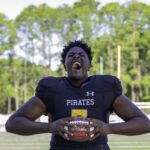
Florida has landed a commitment from four-star tight end Heze Kent.
Kent is a 6-foot-6, 310-pound tight end from Brunswick High School in Brunswick, Georgia.
He chose the Gators over Florida State Miami and Texas, and ranks as the No. 11 athlete in the country, the No. 18 recruit in Georgia and the No. 167 overall recruit in the 2026 class.
What Kent looked for most in a school throughout his recruitment is a place where he can feel comfortable, but he also wanted a place where he’s seen as a true, pass-catching tight end at the next level.
Because of his size at 310 pounds, not all schools that recruited him looked for him to line up at tight end.
Kent’s top four schools in Florida, Florida State, Miami and Texas all saw him as a tight end, which brought each school into his final cut.
What helped separate Florida, however, was Kent’s relationship with offensive coordinator and tight ends’ coach, Russ Callaway.
“That’s like a father or a brother to me,” Kent said. “My coach had told me how he was as a person, like the same person he is on the field is the same person he is off.”
Kent was able to have some familiarity with Callaway before Florida began recruiting him heavily. Callaway played football at Valdosta State with Kent’s high school coach, so that gave Kent a unique perspective on what to expect from Callaway.
The relationship grew on its own, however, and that combined with how Florida sees him in the offense gave Kent a lot to like about the Gators.
Kent kept his recruitment relatively private and even keeled, especially down the stretch. Florida State made a push close to his decision, especially after his official visit with the Seminoles.
“Everything has been good over there,” Kent said ahead of his decision. “I talk to Coach [Chris] Thomsen and Coach [Mike] Norvell.”
What helped give Florida the nod, however, was the fact that the staff not only treated him as a priority, but as a priority tight end throughout much of his recruitment
“They say no other tight end that they’re recruiting has the same skillset as me,” Kent said.
Here is what National High School Scouting Analyst Hudson Standish had to say in late June on Kent’s game.
“One of the more unique evaluations in the 2026 cycle. Jumbo athlete hovering around 6-foot-6, 310 pounds who primarily plays tight end at the prep level but likely projects to offensive tackle or defensive tackle on Saturdays. Shows significant developmental blocking upside when asked to stay attached, possesses nimble movement skills and redirection ability that directly translate from his work as a forward on the basketball court. Uncommon movement skills from a player of his size in the open field and will make acrobatic ladder-climbing snags in the red zone. Dominates South Georgia 5A competition in a variety of ways and has even found success as a ball carrier. Could start his career as a specialty tight end in 12/13 personnel groupings before transitioning to a long-term positional home. Sheer size and athleticism point to obvious long-term NFL upside, especially if he embraces a role along the offensive or defensive line at the next level.”
The Gators landed a unique unicorn with size and athleticism. Kent adds to an impressive group Coach Napier is bringing in for 2026.
Online
Radio/Podcasts