Georgia Bulldogs
Georgia Memories

 By: Joe Delaney
TheSouthernSportsEdition.com news services
Well, here we are with the latest installment pf the “World’s Largest Outdoor Cocktail Party”.
This year’s edition has twist and turns as is usual in this heated rivalry.
Gone is Billy Napier and the Gators are in disarray. The Dawgs are ranked #5 and should win easily right? Not so fast………….
When you look at the history of the rivalry it makes you realize how scary a game this is for the Dawgs.
The Gators have absolutely nothing to lose and that makes them very dangerous. The Dawgs better be ready to play because this IS the biggest game for Florida and stranger things have happened.
Let’s look at a few of the great games, notes and players in Georgia Florida history through the Bulldogs eyes.
Let’s start at the beginning. Did you know the two schools can’t even agree on how many games have been played?
Florida says that the 1904 game doesn’t count because that was the University of Florida Lake City. Well Georgia won the game 52-0 played in Macon. The great UGA historian Dan Magill remarked many years later, “that’s where Florida was back then. We can’t help it if they got run out of Lake City.” Now that’s how you start a rivalry!
Who can forget the 1975 game and the amazing Larry Munson. Yes it’s the Appleby to Washington game with Larry being ……well Larry!
With 3:10 left in the fourth quarter Vince Dooley calls an end around pass. Larry takes it from there………“and Washington caught it thinking of Montreal and the Olympics and ran out of his shoes right down the middle 80 yards!” Georgia goes on to win 10-7.
A year later it was Florida leading the Dawgs 27-20 in the third quarter. Head Coach Doug Dickey has a brain fart of epic proportions and goes for it on 4th and 1 from his own TWENTY NINE yard line. Florida gets stuffed and Georgia goes on to win 41-27. The play and the game are always remembered as “fourth and dumb”.
Ah yes, 1980. No column on the Georgia/Florida game is done without it. A strong dose of Herschel and a shot of Buck and Lindsay! The great Larry Munson ends the call of Buck and Lindsay with “man is their gonna be some property destroyed tonight! I gave up….you did too….out of it…..out of it and gone. Miracle!” Nuff said.
In 2007 it was the “Gator Stomp”. Georgia’s Knowshon Moreno dives into the endzone for a first quarter touchdown and the ENTIRE Georgia team runs on the field. Georgia goes on the sack Heisman winner Tim Tebow 6 times in the 42-30 Georgia win.
And who can forget the “evil genius” aka Steve Spurrier. Ole Stevie went 11-1 against the Dawgs in his Tenure as Head Coach of the Gators.
He was a brilliant coach and probably loved beating the Dawgs more than anything. His “fun and gun” offenses had some of basics of what offenses run today.
So why did Spurrier have such a distain for Red and Black? It goes back to 1966.
Dooley’s Dawgs roll into the old Gator Bowl to face the Heisman winner Spurrier and the Gators. Well, the Dawgs intercept Spurrier 3 times and he was constantly harassed by Bill Stanfield, the Georgia great.
In the funniest quote I’ve ever seen the good old country boy Stanfield would say, “holding pigs for my dad to castrate was quite a challenge. I can’t say that it helped me prepare for football, but it sure did remind me an awful lot of sacking Steve Spurrier”!
Yeah its Georgia Florida. The old boys from Florida have their share of golden memories also. That’s what makes it so great. For many it’s the biggest game of the year.
No matter what the records are. Its Georgia Florida, a great big slice of Americana. Strap em up Dawgs and don’t forget that injured Gators are dangerous.



Let’s Play Here

 By: Jeff Doke
TheSouthernSportsEdition.com news services
For over nine decades, the annual clash between the Georgia Bulldogs and Florida Gators has been more than a football game; it’s a cultural phenomenon.
Hosted almost exclusively in Jacksonville since 1933, this SEC rivalry draws over 80,000 rabid fans to EverBank Stadium, injecting an estimated $50 million into the local economy each year through hotel stays, bar tabs, and Bulldog-Gator-fueled revelry along the St. Johns River.
But as EverBank Stadium, the 30-year-old home of the Jacksonville Jaguars, faced obsolescence, whispers grew about relocating the game permanently to campus sites or other neutral venues.
Enter the “Stadium of the Future.”
A renovation project that’s not just revitalizing an aging sports facility but safeguarding Jacksonville’s cherished tradition, the $1.4 billion project was approved unanimously by NFL owners in October 2024.
The overhaul began in February 2025 and is slated for completion by the 2028 season.
Funded roughly equally by the city and Jaguars owner Shad Khan, the project commits the team to a 30-year lease, dispelling relocation fears.
Construction will disrupt play. Jaguars games will run at reduced capacity in 2026 before the team relocates temporarily to either Orlando or Gainesville in 2027 but crucially, it spares the 2025 Florida-Georgia matchup.
More importantly, the upgrades are engineered to lure the rivalry back post-renovation, ensuring its return from 2028 to 2031 under a freshly inked four-year extension announced in November 2024.
At the heart of this strategy is expanded capacity tailored for college football’s biggest bashes. EverBank’s current setup holds 67,838 for Jaguars games but swells to over 82,000 for the Cocktail Party with temporary seating.
The renovated stadium drops to a sleek 63,000 permanent seats for NFL action—optimizing sightlines and revenue but boasts expandable configurations up to 71,500, with potential for 70,000-plus in special-event mode.
This isn’t arbitrary; university athletic directors from Florida and Georgia collaborated directly on the design, insisting on features that accommodate the game’s unique chaos: massive tailgate zones, riverfront access for yachts, and reinforced structures for the influx of RVs and vendors that turn Jacksonville into the epicenter of college football.
The upgrades go far beyond seating. A groundbreaking protective canopy will shade fans from Florida’s brutal sun and afternoon thunderstorms, creating a climate-controlled bowl that feels premium without enclosing the open-air vibe.
Wider elevated concourses will ease the pre-game crush, while new seating tiers offer everything from field-level suites to sky-high club seats.
Enhanced digital tech, including upgraded lighting, massive video boards, and seamless Wi-Fi, ensures modern amenities like instant replays and app-based concessions, appealing to younger demographics in an era of streaming and NIL deals.
The current deal nets each university $5-5.5 million annually, but post-2028, payouts jump to at least $10 million per school, plus travel stipends ($350,000 for Georgia, $60,000 for Florida).
Unlike before, Jacksonville retains all ticket, concession, and merchandise revenue, making the game profitable for the city while sweetening the pot for the schools.
During the interim, $1.5 million per university in 2026 and 2027 covers relocation to Atlanta’s Mercedes-Benz Stadium and Tampa’s Raymond James Stadium—neutral sites that preserve the game’s off-campus ethos but lack Jax’s intimate, party-hard charm.
Skeptics might point to college football’s seismic shifts; conference realignments, playoff expansions, and revenue chases that moved the Red River Rivalry fully on-site.
Georgia coach Kirby Smart once floated playing at Sanford Stadium for recruiting perks, but the mutual $10 million guarantee and Jacksonville’s proven track record quashed that. The city’s deep ties, from co-sponsoring RV lots to hosting fan fests, create an unmatched ecosystem.
By 2028, when the Gators and Bulldogs return, EverBank won’t just be renovated, it’ll be reborn as a multipurpose marvel, drawing concerts, WrestleMania, and more while prioritizing this annual October ritual.
The upgrades don’t merely fix a leaky roof; they fortify a legacy, ensuring Jacksonville remains the beating heart of college football’s wildest weekend.
In a sport chasing the next billion, sometimes the best play is doubling down on tradition.
Let’s Agree To Disagree

 By: Colin Lacy
TheSouthernSportsEdition.com news services
The annual rivalry between the Georgia Bulldogs and the Florida Gators is unquestionably one of (some would argue the single best) best rivalries in college football.
That is one of the very few things that the two teams and fanbases can agree on.
They don’t agree on the name. If you’re dawned in red and black, it’s the Georgia/Florida game. If you’re dressed head to toe in orange and royal blue, it’s the Florida/Georgia game. They certainly don’t agree on who the better team or players are and heck, they don’t even agree on when the first game is!
In the history books in Athens, Georgia recognizes the first matchup with Florida took place in Macon, Georgia way back in 1904. Georgia ended up with the victory with a final score of 52-0.
The only problem was that contest wasn’t against what we know as the Florida program. The 1904 meeting saw the Dawgs square off against the “University of Florida Blue and White” that was based out of Lake City, FL (about 45 miles north of Gainesville) and had been known as in the years prior as Florida Agriculture College. This institution was one of four predecessors to the modern-day University of Florida in Gainesville.
The current University of Florida was officially established in 1905 and created a football team beginning in 1906 (almost 2 years after what Georgia claims as the first meeting). The current Florida Gators athletics records don’t include games played by predecessor institutions.
Georgia, however, is adamant that the game counts. Georgia historian and former tennis coach Dan Magill told author of the book “I Love Georgia/I Hate Florida,” Patrick Garbin that “That’s where Florida was back then. We can’t help it if they got run out of Lake City.”
While Florida doesn’t claim the first game in the series against Georgia, the University of Florida does claim traces back to the 1850s on their UF website:
“The University of Florida traces its beginnings to 1853 when the state-funded East Florida Seminary acquired the private Kingsbury Academy in Ocala. After the Civil War, the seminary was moved to Gainesville. It was consolidated with the state’s land-grant Florida Agricultural College, then in Lake City, to become the University of Florida in 1905 and the Gainesville site for the campus was chosen in 1906. Classes began on September 26, 1906, for 102 students.”
The first mutually agreed upon contest took place in Jacksonville on a mid-October afternoon in 1915. The result wasn’t quite as lopsided but resulted in a Georgia convincing win over Florida 37-0.
It took thirteen years for Florida to notch their first victory in the budding rivalry, defeating Georgia 26-6 in 1928.
The two teams have met every year since 1926 aside from the 1943 season when Florida didn’t field of team due to World War II
Although the first mutually agreed game was in Jacksonville, it wasn’t until 1933 when the city became the official home for the game and has been the home for all but two (1994 and 1995) since that 1933 meeting.
So, when the stadium is divided and the 104th meeting (or 103rd depending on which camp you’re in) kicks off, remember the history runs deep. The history of passion, football and not agreeing on anything…not even when the hate started.
Jason Bishop Show October 23 2025

G-Day
 By: Kenneth Harrison
TheSouthernSportsEdition.com news services
The Georgia Bulldogs recently played the G-Day Spring game. That is significant because some programs like Nebraska have chosen not to play a spring game.
With the transfer portal some teams say that causes other programs to poach players. That is why the UGA spring game was not televised.
This game featured the Red Team (No. 1 offense/second team defense) against the Black Team (No. 1 Defense/second team offense). The Red Team won 34-17. The announced attendance for the game was 35,003.
The offense had 88 pass attempts and just 44 rushing attempts. Gunner Stockton took every rep with the first-team offense in the first half. Defenders aren’t able to hit the quarterback, while it often plays very vanilla coverage and rarely blitzes.
Projected starting quarterback Gunner Stockton passed for 309 yards, 2 touchdowns, 1 interception and he completed 50% of his pass attempts.
Backup QB Ryan Puglisi had 49 pass attempts. He was inconsistent but he did throw a touchdown pass to Colbie Young on his first chance playing with the starting offense. He did throw an interception that was picked off by Dominick Kelly shortly before halftime.
Third-string quarterback Colter Ginn led a touchdown drive to start the second half. He threw a seven-yard TD to London Humphrey’s.
“Some good and bad for both, but that’s the way spring games go,” Kirby Smart said. “We’ve got to play some loose plays, throw the ball around, got to do some two-minute.
Excited about the guys that got to play. We’ve got a lot of work to do in terms of offseason and getting ourselves where we need to be for next year, but a lot of the mid-years got valuable minutes. I can remember when mid-years kind of went with the threes and fours, and now it seems like more of them are going with the twos.
“That’s just the way of college football right now.”
The defensive backs looked good in this game. Daniel Harris prevented a deep pass to Noah Thomas on the opening drive. He intercepted Stockton in the end zone later in the first quarter.
The leading receiver for the first-team offense was Dillon Bell. He had 5 receptions for 78 yards. He also had a 13-yard rush to showcase how versatile he is. Junior London Humphreys had 4 receptions, 77 yards and 2 touchdowns.
“London’s very smart,” Smart said of Humphreys after the scrimmage. “He doesn’t have a lot of anxiety, he’s very mature, and he’s good for those kids in that (group) because he works really hard.”
Kicker Peyton Woodring made field-goal attempts of 44 and 35 yards. Liam Badger made a 23-yard field goal.
The offensive line was missing Monroe Freeling and Daniel Calhoun, as both recover from injury.
The defensive line is very young and they were in a tough position dealing with 88 pass attempts. They lost a lot of talent to the upcoming 2025 NFL draft so they need to gain more experience.
“We (have) got to get better,” said Smart when asked about all the redshirt freshmen playing on the offensive and defensive lines.
The Bulldogs will open the 2025 season August 30th at home against Marshall.
Jason Bishop Show February 27 2025
Jason Bishop Show January 16 2025
Jason Bishop Show January 9 2025
Jason Bishop Show October 24 2024
Hall Of Fame
 By: Robert Craft
TheSouthernSportsEdition.com news services
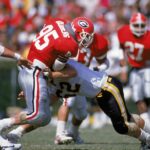
The city of Jacksonville announced on Tuesday that Bill Goldberg, the former University of Georgia defensive tackle who helped the Bulldogs win three of four games against the Gators, will be among the 2024 inductees into the game’s Hall of Fame.
Goldberg will be inducted with Florida cornerback Fred Weary, a Mandarin High graduate, former Jacksonville Jaguars linebacker Mike Peterson, and UGA cornerback Mike Fischer of Jacksonville, a Bolles graduate.
Goldberg was a two-time All-SEC player and lettered four years for the Dawgs from 1986-1989. He’s still ninth in Georgia history with 348 tackles.
But when injuries curtailed his NFL career after stops with the Los Angeles Rams and Atlanta Falcons, Goldberg dropped his first name and became one of the dominant professional wrestlers with a career of more than two decades that culminated with his induction into the WWE Hall of Fame in 2018.
Using moves such as “The Spear” and “The Jackhammer,” Goldberg was a five-time world champion in World Championship Wrestling and World Wrestling Entertainment and at one point was reputed to have gone on a 173-0 streak.
He wrestled competitively off and on from 1997-2018 and also has dabbled in mixed martial arts and acting. He appeared in Adam Sandler’s remake of “The Longest Yard” and was a contestant on “Celebrity Apprentice.”
Fisher, who began his college career at Furman, transferred to Georgia as a walk-on and earned a scholarship in 1978. He played on three Georgia teams that went 3-0 against the Gators from 1978-1980 and had an interception against the Gators in the 1979 and two in 1980.
Fred Weary played for the Gators from 1994-1997 and was on three winning teams against Georgia, including the two games that were played on the campuses in 1994-1995 when UF won by combined scores of 104-31.
Weary had 15 career interceptions to lead Florida, six in his senior season. He was first-team All-SEC.
Weary played six years in the NFL, for New Orleans, Atlanta and the St. Louis Rams. He had seven interceptions as a pro.
Mike Peterson, a Gainesville native who played high school football at Alachua Santa Fe, stayed home to play for the Gators and was on three teams that beat the Bulldogs in four years from 1995-1998. Peterson had 249 tackles in four seasons and also was first-team All-SEC.
Weary and Peterson both started for the Gators’ first national championship team under Steve Spurrier in 1996.
Peterson played in the NFL for 14 years, with Indianapolis, the Jaguars and Atlanta. He had 883 tackles and 19 interceptions. He is currently on the Florida coaching staff.
Online
Radio/Podcasts