Florida Gators
QB Comparision

 By: Colin Lacy
TheSouthernSportsEdition.com news services
The matchup between the Florida Gators and the Georgia Bulldogs has been full of outstanding games, Hall of Fame players and oddities all the same, but virtually every year, the game has seen a matchup of great quarterbacks.
Names like Rick Casares in the early days to Steve Spurrier, Buck Belue, Aaron Murray stood out in this Jacksonville based event.
This year’s rendition of the rivalry will see Georgia’s Gunner Stockton square off with DJ Lagway for the Gators. Both are relatively familiar within their respective fanbases, but let’s dive into the two signal callers.
Florida’s DJ Lagway will be going into his 15th career start and carries a 9-5 record as a starter. 2025 has been a slow start with the only FBS win of the year coming against Mississippi State.
Much of the “slow start” was because of missing much of the spring and fall camp with injuries.
Lagway was a highly heralded recruit coming out of Willis High School in Texas. His high school career was capped off with being named the National Gatorade Player of the Year and finished with 8,392 passing yards and 100 touchdowns (58 coming in his senior year).
Last season, he began the season as QB2 but was thrown into the fire after Graham Mertz went down with injury early in the season. Lagway would finish with 1,900 passing yards with 12 TDs and 9 picks thrown.
The freshman Gator racked in the FWAA and ESPN Freshman All American honors.
There were high hopes entering the season, but the 2025 campaign has been an up-and-down affair.
The lows came in the matchup with the Bayou Bengals when he threw 5 interceptions against LSU on September 13th.
However, since then, in the last four games, Lagway has only thrown 3 picks since. The previous three games before the bye week were arguably the most consistent of Lagway’s career.
The Sophomore slinger threw for 280 yards in the win against Mississippi State while connecting on 20 of 34 passes and neared the 300-yard mark against the 9 Texas Longhorns when DJ went 21-28 through the air with 298 yards and a pair of touchdowns.
Lagway has unreal talent and may be coming into his own finally in his Florida career.
On the flip side Georgia has been breaking in a first year starting quarterback, but a familiar name for Bulldog fans. Gunner Stockton took over the full time QB1 role as a redshirt-junior after serving as the backup to Carson Beck the last two seasons in Athens after redshirting in 2022.
Stockton comes from the athletic family and a “coach’s kid.” Gunner’s dad, Rob, was a Georgia Southern Hall of Fame safety from 1992-1995 and had a huge impact on the development of Gunner (to the point that Gunner wears “14” because that was what his dad wore in the Blue and White with the Eagles.
Stockton’s mom was also a collegiate athlete playing for Erskine women’s basketball in the 90’s in Due West, SC. Stockton (similar to Lagway) was thrust into the fire last season, but on a much larger scale.
Stockton had to come in to finish the first half and play the entirety of the 2nd half of the SEC Championship game against Texas last season when Carson Beck wind down with an injury.
The hard-nosed Stockton set a career high passing in his first true road game of his career when he connected for 304 yards against the Tennessee Volunteers in week 3 of the year.
So far, Stockton is completing 70 percent of his passes and has already eclipsed 1,500 yards through the air to go along with averaging 5.7 yards per carry on the ground this year.
While both are still relatively new in the starting role of QB1, both QBs have shown glimpses at least of greatness.
Stockton has been more consistent throughout the season, but Lagway could quiet the naysayers that want to bring up the 5-interception game with a big showing in Jacksonville.



Georgia Florida Game Hall Of Fame Class

 By: Robert Craft
TheSouthernSportsEdition.com news services
The Florida-Georgia rivalry is one of college football’s most enduring traditions, and each year the Florida-Georgia Hall of Fame honors former players, coaches, and contributors.
Established in 1995 by the City of Jacksonville’s Office of Sports and Entertainment (later associated with Jacksonville’s sports and tourism arms), the Florida-Georgia Hall of Fame celebrates those who left indelible marks on the Florida–Georgia rivalry.
Each year, two representatives from the University of Florida and two from the University of Georgia are selected and formally inducted at a luncheon held on the Friday before the annual Florida-Georgia football game in Jacksonville — a weekend now embraced by SEC fans as part of the “Florida-Georgia Weekend.”
Jacksonville plays host to fan events and the buildup to what is often called “the world’s largest outdoor cocktail party” in college football lore. Here are 2025’s honorees:
Brandon James: James might be the most electric return specialist in Southeastern Conference history. Competing for Florida from 2006 to 2009, he appeared in 50 games, leaving a statistical legacy: four SEC records and eleven Florida records, including career kickoff return yards (2,718), punt return yards (1,371), most total kick returns (229), and total return yardage (4,089).
He is among the select few Gators to have returned both a punt and a kickoff for a touchdown, finishing with five return scores in total.
His accolades include 2008 SEC Special Teams Player of the Year, FWAA All-America honors, and multiple All-SEC designations.
Beyond special teams, he chipped in offensively (as a receiver and rusher), contributing more than 700 yards and additional scores.
During his era, Florida claimed two SEC championships and a 2008 BCS national title — and James was a key weapon in shifting momentum and field position.
Todd Johnson: A stalwart in Florida’s secondary from 1999 through 2002, Todd Johnson started 35 games and played in 47.
He was twice named First-Team All-SEC (2000, 2001) and Second-Team in 2002.
Over his career, Johnson amassed 284 tackles, executed 40 “big plays” (including nine interceptions, eight fumble recoveries, and three blocked kicks), and led the team in total plays two years in a row.
His 2000 season was a highlight: 102 tackles and 5 interceptions in a single year.
Off the field, he earned SEC Academic Honor Roll recognition.
After college, he was selected in the 4th round of the 2003 NFL Draft by the Chicago Bears and went on to play in the NFL with the Bears, Rams, and Bills, totaling 80 games and accumulating 196 tackles, two forced fumbles, two fumble recoveries, and a sack.
Freddie Gilbert: Gilbert was a rock on Georgia’s defensive front from 1980 to 1983.
Notably, he posted an undefeated 4–0 record against Florida during his career, anchoring some of Georgia’s most memorable rivalry victories — including a 44–0 shutout in 1982 and a tight 10–9 win in 1983. In 1981, he logged eight tackles (three for loss) against Florida, prompting then-coach Vince Dooley to laud his “outstanding” effort.
Over four seasons, Gilbert racked up 233 tackles and 26 sacks, ranking sixth all-time at Georgia, and set the school’s single-game sack record with five against Temple in 1983.
He earned two First-Team All-SEC nods and was a 1983 All-American. After college he played professionally in the USFL and later in the NFL, including appearances in Super Bowls XXI and XXII with the Denver Broncos.
Sony Michel: Michel was a prolific running back for Georgia from 2014 to 2017, and his performances in rivalry games and postseason matchups cemented his place in Bulldog lore.
In his final Florida–Georgia game, he rushed for 137 yards and scored two long touchdowns in a dominant 42–7 win.
During his collegiate tenure, Michel amassed 3,638 rushing yards, 33 touchdowns, and added more than 600 receiving yards, becoming the third-all-time leading rusher at Georgia.
He was a two-time permanent team captain, and he led Georgia to the 2017 SEC Championship and a berth in the College Football Playoff.
Michel’s final college season included a standout performance in the Rose Bowl with 181 yards and three touchdowns, propelling Georgia to the national title game.
In the NFL, Michel was selected in the first round by the New England Patriots and went on to win two Super Bowls — famously scoring the only touchdown in Super Bowl LIII — before later joining and winning another title with the Los Angeles Rams.
The 2025 inductee class continues the Hall’s mission to spotlight those whose impact rippled beyond individual games.
Their achievements in Florida–Georgia matchups, on broader stages, and in post-collegiate careers embody the rivalry’s blend of excellence, drama, and enduring loyalty.
The Jacksonville luncheon remains more than an award ceremony — it’s a gathering of the rivalry’s past and present, connecting generations of fans, players, and media in celebration of one of college football’s greatest traditions.
As October 31 approaches and fans flock to Jacksonville, the 2025 Hall of Fame class will be immortalized among the legends of the Florida-Georgia rivalry — their stories woven into the fabric of one of the sport’s most storied matchups.
Jason Bishop Show October 30 2025


The War For The Oar

 By: Michael Spiers
TheSouthernSportsEdition.com news services
Few games in college football have the same feel as Georgia–Florida.
Every fall, the Bulldogs and Gators meet in Jacksonville for a border war that splits families, fills the stands with half red and black and half orange and blue, and reminds the rest of the country how much fun a real rivalry can be.
Depending on which record book you believe, the two first met in either 1904 or 1915, but since 1926 they’ve battled nearly every year, taking only one break during World War II.
The matchup has lived in Jacksonville since 1933, which is considered neutral ground right on the border, and the party that surrounds it is legendary.
For years, fans called it The World’s Largest Outdoor Cocktail Party, and while the schools have dropped that name officially, the energy hasn’t gone anywhere.
This rivalry has always swung in streaks. Georgia owned the early years, Florida took control in the ’50s and early ’60s, then Vince Dooley’s Bulldogs flipped the script through the ’80s.
The ’90s were all Gators thanks to Steve Spurrier, and Urban Meyer kept it rolling into the 2000s. But lately, it’s been Kirby Smart’s world. Georgia has won seven of the last eight, and they don’t look ready to give it up.
Still, there’s more to this rivalry than touchdowns and bragging rights.
Since 2009, coincidentally around the time the Largest Outdoor Cocktail Party moniker was abandoned, the Okefenokee Oar has added a unique twist to the Georgia–Florida story.
The Oar is exactly what it sounds like. It is a 12-foot wooden oar carved from a 1,000-year-old tree pulled from the Okefenokee Swamp, that massive wetland straddling the Georgia–Florida border.
The swamp’s ownership was once disputed between the two states, which makes it the perfect symbol for this tug-of-war rivalry.
Nobody’s really sure why an oar was chosen. The story goes that an anonymous Florida donor came up with the idea in 2009, and student leaders from both schools ran with it.
One side of the Oar features Georgia’s Bulldog and state crest; the other side shows Florida’s Gator and seal. Down the handle, every score since 2009 is carved in, with enough space to keep track for another 150 years.
Florida won the first two “Wars for the Oar,” but Georgia brought it home in 2011 after a 24–20 win.
Since then, it’s traded hands a few times, usually staying with the winner for three-year stretches.
When the Bulldogs have it, you can find the Oar proudly displayed in the Tate Student Center in Athens, Bulldog side facing out. When the Gators win, the Gator side gets the spotlight in Gainesville.
The original idea for the Oar didn’t come from the athletic departments, but instead came from the students. The University of Georgia and University of Florida student governments teamed up to make it official with a joint resolution in 2011.
Ever since, the winning school’s students have been in charge of hauling the massive thing to Jacksonville for the next game.
When Georgia wins, the Redcoat Band usually gets the honor of bringing it back home on the bus.
The Oar started as a quirky idea, but it’s grown into a genuine part of the rivalry. ESPN’s College GameDay has featured it, fans use the hashtag #WarForTheOar, and it’s become one more layer of pride in a matchup that already oozes history and heart.
This year’s game kicks off November 1, and the stakes are as high as ever. Bragging rights, playoff hopes, and a little piece of carved swamp history are all on the line.
When Georgia and Florida meet in Jacksonville, it’s never just a football game. It’s the annual border battle for the Okefenokee Oar, and there’s nothing quite like it in college football.
Georgia Memories

 By: Joe Delaney
TheSouthernSportsEdition.com news services
Well, here we are with the latest installment pf the “World’s Largest Outdoor Cocktail Party”.
This year’s edition has twist and turns as is usual in this heated rivalry.
Gone is Billy Napier and the Gators are in disarray. The Dawgs are ranked #5 and should win easily right? Not so fast………….
When you look at the history of the rivalry it makes you realize how scary a game this is for the Dawgs.
The Gators have absolutely nothing to lose and that makes them very dangerous. The Dawgs better be ready to play because this IS the biggest game for Florida and stranger things have happened.
Let’s look at a few of the great games, notes and players in Georgia Florida history through the Bulldogs eyes.
Let’s start at the beginning. Did you know the two schools can’t even agree on how many games have been played?
Florida says that the 1904 game doesn’t count because that was the University of Florida Lake City. Well Georgia won the game 52-0 played in Macon. The great UGA historian Dan Magill remarked many years later, “that’s where Florida was back then. We can’t help it if they got run out of Lake City.” Now that’s how you start a rivalry!
Who can forget the 1975 game and the amazing Larry Munson. Yes it’s the Appleby to Washington game with Larry being ……well Larry!
With 3:10 left in the fourth quarter Vince Dooley calls an end around pass. Larry takes it from there………“and Washington caught it thinking of Montreal and the Olympics and ran out of his shoes right down the middle 80 yards!” Georgia goes on to win 10-7.
A year later it was Florida leading the Dawgs 27-20 in the third quarter. Head Coach Doug Dickey has a brain fart of epic proportions and goes for it on 4th and 1 from his own TWENTY NINE yard line. Florida gets stuffed and Georgia goes on to win 41-27. The play and the game are always remembered as “fourth and dumb”.
Ah yes, 1980. No column on the Georgia/Florida game is done without it. A strong dose of Herschel and a shot of Buck and Lindsay! The great Larry Munson ends the call of Buck and Lindsay with “man is their gonna be some property destroyed tonight! I gave up….you did too….out of it…..out of it and gone. Miracle!” Nuff said.
In 2007 it was the “Gator Stomp”. Georgia’s Knowshon Moreno dives into the endzone for a first quarter touchdown and the ENTIRE Georgia team runs on the field. Georgia goes on the sack Heisman winner Tim Tebow 6 times in the 42-30 Georgia win.
And who can forget the “evil genius” aka Steve Spurrier. Ole Stevie went 11-1 against the Dawgs in his Tenure as Head Coach of the Gators.
He was a brilliant coach and probably loved beating the Dawgs more than anything. His “fun and gun” offenses had some of basics of what offenses run today.
So why did Spurrier have such a distain for Red and Black? It goes back to 1966.
Dooley’s Dawgs roll into the old Gator Bowl to face the Heisman winner Spurrier and the Gators. Well, the Dawgs intercept Spurrier 3 times and he was constantly harassed by Bill Stanfield, the Georgia great.
In the funniest quote I’ve ever seen the good old country boy Stanfield would say, “holding pigs for my dad to castrate was quite a challenge. I can’t say that it helped me prepare for football, but it sure did remind me an awful lot of sacking Steve Spurrier”!
Yeah its Georgia Florida. The old boys from Florida have their share of golden memories also. That’s what makes it so great. For many it’s the biggest game of the year.
No matter what the records are. Its Georgia Florida, a great big slice of Americana. Strap em up Dawgs and don’t forget that injured Gators are dangerous.
Let’s Play Here

 By: Jeff Doke
TheSouthernSportsEdition.com news services
For over nine decades, the annual clash between the Georgia Bulldogs and Florida Gators has been more than a football game; it’s a cultural phenomenon.
Hosted almost exclusively in Jacksonville since 1933, this SEC rivalry draws over 80,000 rabid fans to EverBank Stadium, injecting an estimated $50 million into the local economy each year through hotel stays, bar tabs, and Bulldog-Gator-fueled revelry along the St. Johns River.
But as EverBank Stadium, the 30-year-old home of the Jacksonville Jaguars, faced obsolescence, whispers grew about relocating the game permanently to campus sites or other neutral venues.
Enter the “Stadium of the Future.”
A renovation project that’s not just revitalizing an aging sports facility but safeguarding Jacksonville’s cherished tradition, the $1.4 billion project was approved unanimously by NFL owners in October 2024.
The overhaul began in February 2025 and is slated for completion by the 2028 season.
Funded roughly equally by the city and Jaguars owner Shad Khan, the project commits the team to a 30-year lease, dispelling relocation fears.
Construction will disrupt play. Jaguars games will run at reduced capacity in 2026 before the team relocates temporarily to either Orlando or Gainesville in 2027 but crucially, it spares the 2025 Florida-Georgia matchup.
More importantly, the upgrades are engineered to lure the rivalry back post-renovation, ensuring its return from 2028 to 2031 under a freshly inked four-year extension announced in November 2024.
At the heart of this strategy is expanded capacity tailored for college football’s biggest bashes. EverBank’s current setup holds 67,838 for Jaguars games but swells to over 82,000 for the Cocktail Party with temporary seating.
The renovated stadium drops to a sleek 63,000 permanent seats for NFL action—optimizing sightlines and revenue but boasts expandable configurations up to 71,500, with potential for 70,000-plus in special-event mode.
This isn’t arbitrary; university athletic directors from Florida and Georgia collaborated directly on the design, insisting on features that accommodate the game’s unique chaos: massive tailgate zones, riverfront access for yachts, and reinforced structures for the influx of RVs and vendors that turn Jacksonville into the epicenter of college football.
The upgrades go far beyond seating. A groundbreaking protective canopy will shade fans from Florida’s brutal sun and afternoon thunderstorms, creating a climate-controlled bowl that feels premium without enclosing the open-air vibe.
Wider elevated concourses will ease the pre-game crush, while new seating tiers offer everything from field-level suites to sky-high club seats.
Enhanced digital tech, including upgraded lighting, massive video boards, and seamless Wi-Fi, ensures modern amenities like instant replays and app-based concessions, appealing to younger demographics in an era of streaming and NIL deals.
The current deal nets each university $5-5.5 million annually, but post-2028, payouts jump to at least $10 million per school, plus travel stipends ($350,000 for Georgia, $60,000 for Florida).
Unlike before, Jacksonville retains all ticket, concession, and merchandise revenue, making the game profitable for the city while sweetening the pot for the schools.
During the interim, $1.5 million per university in 2026 and 2027 covers relocation to Atlanta’s Mercedes-Benz Stadium and Tampa’s Raymond James Stadium—neutral sites that preserve the game’s off-campus ethos but lack Jax’s intimate, party-hard charm.
Skeptics might point to college football’s seismic shifts; conference realignments, playoff expansions, and revenue chases that moved the Red River Rivalry fully on-site.
Georgia coach Kirby Smart once floated playing at Sanford Stadium for recruiting perks, but the mutual $10 million guarantee and Jacksonville’s proven track record quashed that. The city’s deep ties, from co-sponsoring RV lots to hosting fan fests, create an unmatched ecosystem.
By 2028, when the Gators and Bulldogs return, EverBank won’t just be renovated, it’ll be reborn as a multipurpose marvel, drawing concerts, WrestleMania, and more while prioritizing this annual October ritual.
The upgrades don’t merely fix a leaky roof; they fortify a legacy, ensuring Jacksonville remains the beating heart of college football’s wildest weekend.
In a sport chasing the next billion, sometimes the best play is doubling down on tradition.
Let’s Agree To Disagree

By: Colin Lacy
TheSouthernSportsEdition.com news services
The annual rivalry between the Georgia Bulldogs and the Florida Gators is unquestionably one of (some would argue the single best) best rivalries in college football.
That is one of the very few things that the two teams and fanbases can agree on.
They don’t agree on the name. If you’re dawned in red and black, it’s the Georgia/Florida game. If you’re dressed head to toe in orange and royal blue, it’s the Florida/Georgia game. They certainly don’t agree on who the better team or players are and heck, they don’t even agree on when the first game is!
In the history books in Athens, Georgia recognizes the first matchup with Florida took place in Macon, Georgia way back in 1904. Georgia ended up with the victory with a final score of 52-0.
The only problem was that contest wasn’t against what we know as the Florida program. The 1904 meeting saw the Dawgs square off against the “University of Florida Blue and White” that was based out of Lake City, FL (about 45 miles north of Gainesville) and had been known as in the years prior as Florida Agriculture College. This institution was one of four predecessors to the modern-day University of Florida in Gainesville.
The current University of Florida was officially established in 1905 and created a football team beginning in 1906 (almost 2 years after what Georgia claims as the first meeting). The current Florida Gators athletics records don’t include games played by predecessor institutions.
Georgia, however, is adamant that the game counts. Georgia historian and former tennis coach Dan Magill told author of the book “I Love Georgia/I Hate Florida,” Patrick Garbin that “That’s where Florida was back then. We can’t help it if they got run out of Lake City.”
While Florida doesn’t claim the first game in the series against Georgia, the University of Florida does claim traces back to the 1850s on their UF website:
“The University of Florida traces its beginnings to 1853 when the state-funded East Florida Seminary acquired the private Kingsbury Academy in Ocala. After the Civil War, the seminary was moved to Gainesville. It was consolidated with the state’s land-grant Florida Agricultural College, then in Lake City, to become the University of Florida in 1905 and the Gainesville site for the campus was chosen in 1906. Classes began on September 26, 1906, for 102 students.”
The first mutually agreed upon contest took place in Jacksonville on a mid-October afternoon in 1915. The result wasn’t quite as lopsided but resulted in a Georgia convincing win over Florida 37-0.
It took thirteen years for Florida to notch their first victory in the budding rivalry, defeating Georgia 26-6 in 1928.
The two teams have met every year since 1926 aside from the 1943 season when Florida didn’t field of team due to World War II
Although the first mutually agreed game was in Jacksonville, it wasn’t until 1933 when the city became the official home for the game and has been the home for all but two (1994 and 1995) since that 1933 meeting.
So, when the stadium is divided and the 104th meeting (or 103rd depending on which camp you’re in) kicks off, remember the history runs deep. The history of passion, football and not agreeing on anything…not even when the hate started.
Jason Bishop Show October 23 2025
The Path
By: Robert Craft
TheSouthernSportsEdition.com news services
Just because there’s no Cinderella, doesn’t mean there won’t be a storybook ending.
In 2025, the crown will go to a No. 1 seed, as all four top dogs — Auburn, Duke, Florida and Houston — advance to the Final Four for the second time in tournament history.
The Blue Devils face the Cougars, while the Tigers take on the Gators, both in San Antonio on April 5th.
The dominance of the SEC has loomed over March, with the conference breaking one record 14 NCAA Tournament bids, then breaking another with seven teams in the Sweet 16. The SEC is also the first conference to have four schools in the regional finals.
Two SEC teams remain, and they’ll meet in one semifinal, while an ACC and Big 12 matchup awaits us on the other side of the bracket.
Florida-Auburn tips at 6:09 p.m. ET, and Duke-Houston follows at 8:49 p.m. ET, both on CBS.
As far as the betting odds go, Duke is the early favorite at -110.
In case you’re new to the madness, let’s review the few remaining teams.
Auburn had three slow starts in their first three games. Against No. 5-seeded Michigan (Sweet 16), the Tigers clawed back from a nine-point deficit in the second half. Auburn closed the game on a remarkable 39-17 run en route to the Elite Eight.
Once there against Michigan State, the Tigers flipped the script, putting together a complete game to end Tom Izzo and the Spartans’ season while surviving a major scare in the process.
Senior forward Johni Broome, the SEC player of the year, went down with an elbow injury with 10:37 left to play and the Tigers leading by 10. He walked off the court shaking his head as he headed to the locker room, but returned five minutes later after his X-ray came back negative, per CBS.
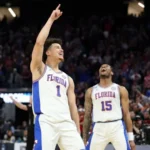
In very March fashion, the Florida Gators almost lost before the Final Four. Florida had to erase a double-digit second-half deficit against Texas Tech in the Elite Eight due to Walter Clayton Jr.’s clutch shot-making.
The 6-foot-3 senior guard finished with 30 points — eight of them in the final 107 seconds — to send the Gators to their first Final Four since 2014. Clayton leads the team in both points (18.1) and assists (4.2).
“There’s not another player in America you would rather have right now than Walter Clayton with the ball in his hands in a big-time moment,” Florida coach Todd Golden said after the Elite Eight comeback.
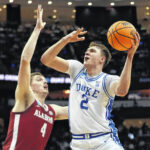
The Duke Blue Devils walked into the NCAA Tournament fresh off an ACC tournament victory, which they conquered without their leader Cooper Flagg, who sat out of the competition with an ankle injury.
Since Flagg’s return for the first round, Duke has won comfortably for the most part. It bested three of their four opponents by double digits, crushing Mount Saint Mary’s in the first round by 44 points. The team then dialed up its top five defense in the Elite Eight against Alabama.
While Flagg leads the team in points (18.9), rebounds (7.5), assists (4.2) and steals (1.4), it was the team’s defense that carried the Blue Devils to ACC regular-season and tournament titles- in addition to the No. 1 ranking and the No. 1 seed.
It is Duke’s first Final Four under coach Jon Scheyer and the program’s 18th overall. The Blue Devils last reached the Final Four in 2022.
Houston had to get past Tennessee. It did so in the Elite Eight, with one of the most impressive defensive performances in NCAA Tournament history.
The Big 12 Conference champions contained the Vols to just 28.8 percent from the field, forced 14 straight missed 3-point attempts to open the game and (yes, you’re about to read this right) held Tennessee to only 15 points in the first half. It marked the lowest scoring first half by a No. 1 or No. 2 seed in NCAA Tournament history.
For the Cougars, performances like this are typical. Houston has not lost a road game this entire season. Led by coach Kelvin Sampson, the program’s holy trinity of defense, rebounding and ball management, always travel well and it’s been well utilized on Houston’s path to the Final Four. Houston had a tough schedule in the Midwest region, knocking off No. 2-seeded Tennessee (69-50), No. 4-seeded Purdue (62-60), No. 8-seeded Gonzaga (81-76) and No. 16-seeded SIU Edwardsville (78-40).
In Sampson’s third Final Four of his career, his Cougars’ reward is Duke, and for the first time in a long time, they’re the underdogs.
Left Standing
 By: Kenneth Harrison
TheSouthernSportsEdition.com news services
All four No. 1 seeds have advanced to the Final Four for the second time in history and the first time since 2008. The teams that made it are Duke (35-3), Florida (34-4), Auburn (32-5) and Houston (34-4).
Surprisingly, the 2008 Final Four was also in San Antonio. That’s the national title game where Kansas beat Memphis and Derrick Rose in overtime.
The SEC had a record of 14 teams make it into the NCAA Tournament. It’s not surprising that two teams are from that conference.
The first national semifinal is between the SEC regular-season champion Tigers and SEC tournament Gators.
“The four teams that are advancing, I think they’re the best four teams in the country,” Auburn coach Bruce Pearl said after his team’s win Sunday. “That doesn’t obviously always happen.”
These teams played February 8th at Auburn and Florida won 90-81. The Tigers beat No. 2 seed Michigan State 70-64 in the Elite Eight. Johni Broome led the team with 25 points and 14 rebounds. The only other Tiger with double figures was freshman guard Tahaad Pettiford with 10 points.
“Unfortunately, there will only be one SEC team playing for the national championship,” Pearl said, also wearing a net around his neck.
This is Auburn’s second Final Four appearance and the first since 2019.
Florida had to rally late to beat No. 3 seed Texas Tech 84-79. The Gators trailed 75-66 with less than three minutes left in the game. Senior guard Walter Clayton Jr. scored 30 points and sophomore forward Thomas Haugh scored 20.
“It goes to show how together we all are,” Clayton said. “Many times could easily just break, start pointing the finger, blaming each other for this and that. But we just stayed together through the end and stayed the course. And thankfully we got it done today.”
Todd Golden took over as the head coach in Gainesville in 2022. The Gators have improved in each season under him. This is Florida’s sixth Final Four appearance and the first since 2014.
The second game is Houston and their top-rated defense against Duke’s top-ranked offense.
The Blue Devils are a blue blood program and they have been led by freshman forward Cooper Flagg this season.
They defeated No. 2 seed Alabama 85-65 in the Elite Eight. Freshman guard Kon Knueppel had 21 points, junior guard Tyrese Proctor scored 17 and Flagg added 16 points.
“To hold them to 65 points is incredible,” Duke coach Jon Scheyer said. “We watched them play the other night. They scored 113 and made 25 3s. The biggest thing for us was not taking the bait of getting so spread out.”
This is Duke’s 18th Final Four appearance and the first since 2022. That last appearance came in Mike Krzyzewski’s final season. Scheyer took over after he retired.
The Cougars beat No. 2 seed Tennessee 69-50 in the Elite Eight. Senior guard L.J. Cryer scored 17 points and junior guard Emanuel Sharp had 16 points.
“It’s a good feeling knowing what we’ve been through,” Sharp, the region’s most outstanding player, said of Houston’s first Final Four appearance since 2021. “A lot of people doubted us.”
This is Houston’s seventh trip to the Final Four and the first since 2021. Head coach Kelvin Sampson became the head coach in 2014 after previously being the head coach at Washington State, Oklahoma and Indiana.
I think Duke and Florida will advance to the national title game. I expect the Blue Devils to win.
Online
Radio/Podcasts