Southern Sports Edition
Brunswick High Pirates Coach’s Show w Byron Slack September 21 2026





Camden County Wildcats Coach’s Show with Tucker Pruitt September 22 2026

Top Teams In 7A

 By: Kenneth Harrison
TheSouthernSportsEdition.com news services
We’re almost at the midway point for the high school football regular season. I want to take a look at some of the top teams in 7A and see how they have done thus far.
#1 Buford: The Wolves are the top team in the state and ranked #4 nationally by USA Today. They are reigning state and national champions. They have beaten some strong teams like #6 Gainesville (6A), Miami Central (FL) and Grayson.
They got a boost after Week 1 when five-star defensive lineman Jalen Brewster transferred in from Texas. He’s also rated #4 nationally for the class of 2027.
They’re about to start region play this week. AAAAAAA Region 8 is extremely weak. There’s only one other team that has at least a .500 record.
#2 Carrolton: The Trojans are always competing for a state title but coming up just short. They were 14-1 last season, with the only loss coming to Buford in the state championship game. They also lost the state championship in 2024 and 2022.
There are only three other teams in AAAAAAA Region 2 but they are tough. They consist of Douglas County, #8 Westlake and East Coweta. Carrolton is a legit contender. They are ranked #12 nationally.
#3 Newton: This is an odd position for the Rams because they aren’t a traditionally good program. They have a lot of talent on the roster this year like four-star RB Kevin Hartsfield.
They started the season with a double overtime win against Douglas County. Since then, it’s been all blowouts. A couple of notable teams they beat are #8 Roswell (6A) and Warner Robins.
They’ll start October playing at #8 Westlake. They also have Grayson and Archer in their region, so we will find out if The Rams are contenders.
#4 North Gwinnett: The Bulldogs advanced to the state semifinals last season. They picked up where they left off and they have not played a close game yet. They’ve won every game by double digits, with the closest margin of victory being 13 points.
They’ve already started region play but they will play the tough teams later in the season. That includes #6 Brookwood, Peachtree Ridge and Parkview.
#5 Lowndes: The Vikings are also beating up on the competition. They finished last season 10-2, losing in the second round of the playoffs to North Gwinnett. They start play in AAAAAAA Region 1 October 9th, which is considered the toughest region in the state.
That consists of Camden County, Richmond Hill, #7 Valdosta and #10 Colquitt County. The Vikings are looking to win their first state title since 2007.
#6 Brookwood: The Broncos have looked good so far. They were 10-3 last season, so they have started to get back to being one of the best programs in Gwinnett County. I spoke about AAAAAAA Region 7 earlier when I talked about North Gwinnett, so I won’t mention that here. Their last state title was in 2010.
#7 Valdosta: The Wildcats have more wins than any football program in the country. They also have 24 state championships, with the most recent from 2016. They advanced to the state semifinals last season, before losing to Buford.
This team knows how to win but things will get tougher when they begin region play in mid-October.
#8 Westlake: The Lions are playing well. This school is known for producing talented players like Cam Newton, Adam “Pacman” Jones, Malik Willis, Chance Warmack and A.J. Terrell.
They get to the playoffs consistently but have never won a state championship.
October In Region 1-7A

 By: Ron Reagin
TheSouthernSportsEdition.com news services
Region play has not started in Region 1-7A. That changes in October.
The five-team region — Valdosta, Lowndes, Colquitt County, Camden County and Richmond Hill — has spent September on non-region slates.
The records look good, but the standings do not mean as much yet. The next five weeks will decide the region title, the first-round home game, and most of the PSR seeds that follow.
The non-region schedules for the majority of Region 1-7A has been managed well by all teams. Colquitt has suffered a couple of early losses, as well as Camden. Luckily for them, Region 1 is an equalizer if they can win in one of the toughest regions in the state.
The October-November gauntlet
Region games come in a tight cluster:
Oct. 9 — Colquitt at Richmond Hill; Lowndes vs. Camden
Oct. 16 — Valdosta at Colquitt, Richmond Hill @Camden
Oct. 23 — Camden at Valdosta; Lowndes at Richmond Hill
Oct. 30 — Lowndes vs. Valdosta (Winnersville Classic); Colquitt at Camden
Nov. 6 — Lowndes at Colquitt; Richmond Hill at Valdosta
That is 10 region games in a five week span spilling over into the first week of November.
Every one of them counts twice: once in the region standings, and once in the PSR formula that will seed the 7A playoffs statewide.
What each team needs:
Valdosta has the best early PSR profile in the region and is projected as a high seed if it takes care of business.
The Wildcats still have to go to Moultrie, host Camden, go to Lowndes for the Winnersville Classic, and close with Richmond Hill. An unbeaten region run would lock up the title and a first-round home game.
Lowndes is 5-0 and has been dominant at home. The Vikings’ non-region wins have not carried much PSR weight. Region wins will.
Hosting Camden, going to Richmond Hill, hosting Valdosta, and finishing at Colquitt is a four-game stretch that will define Adam Carter’s fourth season.
Colquitt has a winning record after losses to Thomas County Central and Lee County.
Those two losses hurt the record and helped the schedule strength. The Packers still have a path to a high seed if they win their share in region play. The home date with Valdosta on Oct. 16 and the finale against Lowndes are the measuring sticks.
Camden needs region wins more than anyone. A decent start and a mid-teens PSR projection leave little margin.
Games at Lowndes, at Valdosta, and at home against Colquitt will decide whether the Wildcats are a playoff team with a decent seed or a team looking in from the outside.
Richmond Hill is off to a tremendous start and still the team the formula has treated the harshest. The early wins have not built much opponent winning percentage.
Hosting Colquitt, hosting Lowndes, and going to Valdosta in the finale is the chance to change that. Those games could flip the PSR picture fast if Richmond Hill can win continue winning in the Region.
Why October matters more this year
The region champion still gets a first-round home game. After that, PSR seeds the field 1 through 32.
A second-place team with a tougher résumé can be seeded higher than a champion from a weaker region. That is why these eight games are not just about first place. They are about who you beat and when you beat them.
Late-season upsets can wipe out a high PSR in a hurry. Region wins, in a tough region, can also climb a team several spots in a single Friday night.
The takeaway
September was about getting ready. October is about the region.
Valdosta and Lowndes enter as the favorites. Colquitt has the schedule profile to stay in the high-seed conversation. Camden and Richmond Hill have to prove it against the teams that will actually show up on the playoff résumé, and more importantly, show up in their PSR.
South Georgia fans are already looking forward to these matchups. This year they also decide the playoff seeds, and that makes October in Region 1 as important as it has been in a long time.
Best Of Bulloch
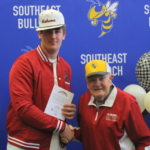
 By: Joseph Stuckey
TheSouthernSportsEdition.com news services
A lot of emphasis gets put on Bulloch County’s current collegiate prospects, but over the past few seasons there have been quite a few players who have made the jump and now play on Saturdays.
With college football in full swing, I thought it would be a good time to highlight some of these players. Below is a list of some of Bulloch County’s standouts at the FBS level organized by graduation year.
First, let’s start with the class of 2026, which produced current Alabama Crimson Tide offensive lineman Bear Fretwell. The 6-7 true freshman lineman was rated as a unanimous 3-star and the 47th-ranked player in the state of Georgia for the 2026 class. The Crimson Tide will look to contend for the SEC title as well as a berth in the CFP.
The class of 2024 was one of those once-in-a-generation classes that produced 3 Power 4 (P4) players at the time. To start with, Portal High School produced Amir Jackson, who took his talents to Gainesville, FL.
The 6-5 tight end was a consensus 4-star and was ranked as a top-15 player in the state of Georgia. Jackson has appeared in 15 games for the Gators and scored a touchdown last season against Texas A&M. Under new head coach Jon Sumrall, the Gators will look to make a run at the SEC title and potentially sneak into the CFP.
Also in the class of 2024, Statesboro High School produced Kam Mikell and Amontrae Bradford. They were a part of the Statesboro team that gave coach Matt Dobson his first postseason win as a Blue Devil.
Bradford was a consensus 3-star and the No. 41-ranked edge rusher in the country. He has appeared in 26 games for the Georgia Tech Yellow Jackets and has accounted for 25 total tackles. He will be a big part of the Yellow Jackets’ defense that will look to bring the first ACC title to The Flats since 2009.
For Kam Mikell, his journey has been a little different. He committed out of SHS to Deion Sanders’ Colorado Buffaloes. During his time there, he appeared in 8 games and then decided to transfer this season to play for his hometown Georgia Southern Eagles.
Mikell was a consensus 4-star and was the number 31 player in the state of Georgia for the 2024 class. His commitment to GSU really energized the fanbase, as he was their highest-rated transfer this past cycle according to 247Sports.
Under head coach Clay Helton, the Eagles have set their sights on winning their first Sun Belt title since 2014.
The final Bulloch County native is from the class of 2023. Jordan Lovett has spent his entire collegiate career with the Troy Trojans.
Lovett came out of Statesboro High School, and picked Troy over Georgia State, Charlotte, and Georgia Southern, among others.
During his time at Troy, he has appeared in 25 games and has 700+ all-purpose yards. This season, the Trojans will be looking to claim their first Sun Belt title since 2023.
As you can see, Bulloch County has quite a few alumni at the FBS level, and the current group of prospects will only add to its growing reputation as a pipeline to the collegiate level.
McIntosh County Academy Buccaneers Coach’s Show September 17 2026

Jason Bishop Show September 17 2026

1-7A Rankings

By: Ron Reagin
TheSouthernSportsEdition.com news services
Region 1-7A has five teams this year — Valdosta, Lowndes, Colquitt County, Camden County and Richmond Hill — but the new GHSA Post-Season Ranking Formula is already separating them.
The formula is winning percentage (35%), opponents’ winning percentage (35%), and opponents’ opponents’ winning percentage (30%). Region champions still get a first-round home game. After that, the 1-32 seeds are driven by PSR, not region finish.
Maxwell’s model takes current results and plays out the rest of the season. For Region 1-7A, the projection (current PSR rank → predicted final seed, with Maxwell power rank in parentheses) looks like this:
Valdosta: 2 → 1 (8)
Lowndes: 7 → 9 (17)
Richmond Hill: 8 → 27 (23)
Camden County 16→ 17 (20)
Colquitt County: 18 → 5 (13)
That is the clearest snapshot of how the formula is working. Valdosta is projected to finish as the No. 1 seed in Class 7A.
Colquitt, sitting 2-2 and 17th in the live PSR, is projected to climb all the way to a No. 5 seed. Lowndes stays in the field as a No. 9. Camden holds around a mid-teens seed. Richmond Hill, unbeaten right now and ninth in the live PSR, is projected to slide to 27.
Who is benefiting
Valdosta is the early winner. The Wildcats are unbeaten and already carrying the region’s best opponents’ winning percentage. Maxwell has them finishing 10-0, winning the region, and coming out as the top seed in the class.
Colquitt County is the other big winner in the formula. The Packers lost to Thomas County Central and Lee County, two of the strongest teams in Georgia. Those losses hurt the record, but they help the schedule strength. That is why a 2-2 team is projected as a No. 5 seed when the season is over.
Camden is holding its ground. A 3-1 start and a decent Florida mix keep them in the playoff picture as a projected 17-seed.
Who is lacking the competition
Lowndes is projected to fall from a high current PSR spot to a No. 9 seed. Wins over Jenkins, Harris County, Lithonia and Blanche Ely look clean, but they do not move the OWP needle much.
Richmond Hill is the cautionary tale. Unbeaten, tied for eighth in the live PSR, and projected to finish 27th.
Wins over Effingham, Liberty County, Jenkins and Ware County have not built enough opponent winning percentage. Unless region play changes that, the formula will treat them as a bubble team, not a high seed.
Schools that play Non-GHSA opponents get no benefit from OWP or OOWP, and only get 0.9 credit in their own WP.
How the region is predicted to finish
Maxwell’s most likely predicted outcomes:
Valdosta 10-0, region champion, PSR No. 1
Colquitt around 7-3, PSR No. 5
Lowndes around 8-2, PSR No. 9
Camden in the mid-teens
Richmond Hill fighting to stay inside the 32
Region play has not started. When these five start playing each other — Colquitt at Richmond Hill, Valdosta at Colquitt, Camden at Valdosta, Lowndes at Valdosta, Lowndes at Colquitt — both the standings and the formula will move at the same time.
Late season upsets could derail a high PSR for post season. Conversely, region wins are going to be key to maintain or gain spots in the PSR for seeding in the playoffs.
The takeaway
PSRF is doing what it was built to do. It is rewarding who you beat, not just that you won.
Valdosta is ahead because it is winning against teams that win. Colquitt is still in the high-seed conversation because it scheduled TCC and Lee County. Lowndes and Richmond Hill have the records. They still need the remaining games, especially region games, to raise the quality attached to those wins.
Bottom line, stats and projections are entertaining to speculate about, but wins in the region are going to be the final determining factor for PSR in 2026.
In a five-team region, every Friday of region matchups matters twice: once in the standings, and once in the formula that will seed the playoffs. October is going to be entertaining in Region 1-7A.
The New Era

 By: Michael Spiers
TheSouthernSportsEdition.com news services
We are now a month into the Tucker Pruitt era at Camden County and I think we are beginning to get a pretty good idea of what this new version of Wildcat football might look like.
It certainly hasn’t been perfect. There have been mistakes, some defensive breakdowns and one tough loss. Most importantly, the Wildcats have already shown they can win in several different ways.
The season began with a strange two-day victory at Brunswick. Lightning stopped the game Friday night and forced Camden to return Saturday morning to finish it. The Wildcats handled the disruption, leaned heavily on the running game and came away with a 35-21 victory.
A week later, Camden looked much more comfortable offensively in a 42-13 win over Glynn Academy. Xavier Collins threw four touchdown passes, Sean Green caught three of them and the Wildcats rolled up more than 400 yards of offense.
Then came the first real punch in the mouth. Camden went to Savannah and lost 27-23 to a very good Benedictine team. The frustrating part was that the Wildcats had a 23-17 lead entering the fourth quarter and couldn’t finish it.
That’s why I think what happened against Godby might tell us more about this team than either of the first two wins.
This time Camden was the team trailing entering the fourth quarter, 21-18. Godby quarterback Landon Dougherty threw for 416 yards and 5 touchdowns, and there were plenty of moments when it looked like the Wildcats might suffer a second straight close loss.
Instead, Camden scored 21 points in the fourth quarter and found a way to win 39-36. Collins completed 17 of 20 passes for 214 yards and 3 touchdowns, while Green caught 8 passes for 133 yards and 2 touchdowns. Just as importantly, the defense came up with two interceptions at critical moments.
A week after failing to protect a fourth-quarter lead, Camden found a way to erase a fourth-quarter deficit. That’s progress.
Pruitt inherited a program with plenty of talent, but changing coaches always means changing expectations, terminology, schemes and culture. Four games isn’t nearly enough time to judge where the program ultimately goes under Pruitt, but a 3-1 start gives Camden something solid to build on.
The Wildcats still have Ed White and West Broward before an open week gives them a chance to prepare for what really matters, and that’s Region 1-7A play.
Anyone that knows about Region 1-7A knows it’s not a friendly walk in the park. Lowndes and Valdosta are both 4-0 and ranked among the top teams in Class 7A.
Lowndes has been especially impressive defensively, allowing only 14 points through four games, including shutouts of Harris County and Blanche Ely.
Valdosta has gone the opposite direction and simply overwhelmed people offensively. The Wildcats have scored at least 52 points in every game and have piled up 222 points in four weeks.
Richmond Hill is also 4-0, including a 13-7 road win over Ware County last Friday. Then there is Colquitt County, which may be 2-2 but has played a much different schedule, with losses to unbeaten Thomas County Central and unbeaten Lee County.
Nobody has played a region game yet, so all of this is simply setting the stage. Camden begins region play October 9 at Lowndes, followed by Richmond Hill at home, Valdosta on the road and Colquitt County at home. There won’t be an easy Friday night anywhere in that stretch.
But that’s still a few weeks away. For now, Pruitt’s first Camden team is 3-1. They’ve won on the road, won comfortably at home, lost a close one and responded by winning a shootout.
There is plenty left to clean up. But through four games, these Wildcats have also given us plenty of reasons to keep watching.
Frederica Academy Knights Coach’s Show with Brandon Derrick September 16 2026

Online

Radio/Podcasts